I'm sitting at home, contemplating everything we heard yesterday at the Family Conference with Dr. Daanish Hoda in preparation for my allogeneic mini (nonmyeloblative) haploidentical stem cell (bone marrow) transplant.
Tomorrow morning (Friday, February 7), I'll have a central line placed on the left side of my upper chest and then start five consecutive days of chemo to kill off some of my white blood cells to make room for the new stem cells from my sister to grow.
And I can't help feeling like today is the last day of my old life and tomorrow is the first day of my new life. Technically, maybe, I can't truly say that until next Wednesday--the day before my sister's cells are actually transfused into me. However, tomorrow is the first day of the actual regimen, so that's how I'm feeling.
And I'm more optimistic about how effective this transplant is going to be against fighting my cancer and any future outbreaks of it than I was with the autologous transplant I had in August of 2011, when my own cancer-free cells were put back in me. Surprisingly, Dr. Hoda understands my logic and agrees with me.
But I also feel like this second transplant will change me forever. That's a good thing (no more cancer for a while), but it's also a bad thing (as graft-versus-host-disease kicks in and Tressie's cells war against my own). I feel like there will be some GVHD complications that will permanently be with me for the rest of my life.
Like so many things in life, this process has amazing parallels to the gospel of Jesus Christ.
Dr. Daanish said that we'll know the transplant was a success when, after some months or possibly a year have passed, they draw my blood and no longer see the properties of my own blood but see only the properties of Tressie's blood. When they look at my blood, they'll see only her blood. My immune system will be totally replaced by hers at that point, and that transformation will heal me of cancer.
Isn't that just what this life is about in spiritual terms? I'm trying to become like my Savior, Jesus Christ. I'm trying to let Him in me so deeply that when people look at me they see only Him--what He would do and what He would say if He were still on the Earth.
And only by accepting Him and becoming more like Him can He heal me--my sins and the pains and unjustices of this world.
Something to think about :-)
Purple Everywhere
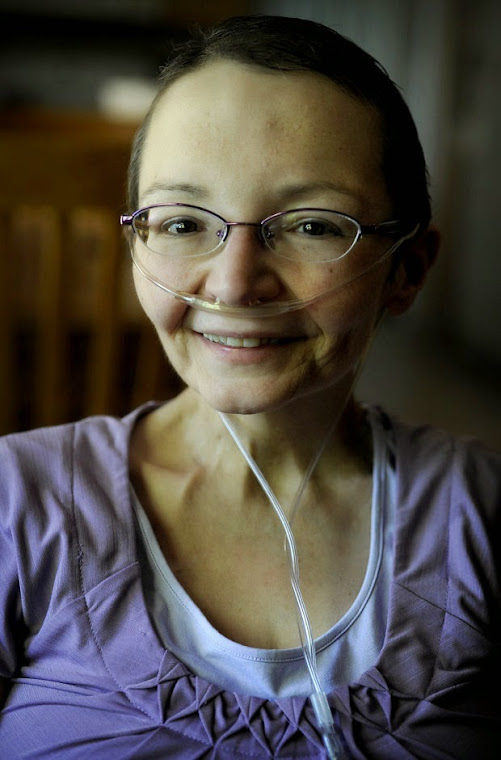
Daily Herald picture
Showing posts with label cancer. Show all posts
Showing posts with label cancer. Show all posts
Thursday, February 6, 2014

Sunday, February 2, 2014
Delays for Second Bone Marrow Transplant
I'm not sure what exactly happened, but I was supposed to have started chemo already, in preparation for my second bone marrow transplant (BMT)--this time an allogeneic haplo transplant.
I do know that my sister, Tabitha, who was going to be my donor said she hadn't been medically cleared to be my donor because she'd been to places in Mexico where there are malaria concerns.
So my sister, Tressie, stepped forward--even though she absolutely is terrified of all things medical, especially hospitals and needles. And I know the BMT team at LDS Hospital told Tressie that she'd be medically cleared, even if she had been to Mexico recently.
Like I said, not sure what happened with Tabitha; but I am grateful that Tressie is willing to be tortured by medical personnel on my behalf.
BUT this all puts a damper on my schedule. I think it's by divine design though.
I feel like things will change for the worse somehow in my life. I feel like the transplant will extend my life for at least a few years (I'm hoping for 7-10), but that there will be some complications from the war between my cells and my sister's that won't be pleasant.
I was just beginning to gear up mentally to start that war when it all had to be postponed while Tressie completed the vetting process, so now I'm just anxious to get it started.
Plus, I feel like, if the transplant doesn't happen within two months of my last chemo dose, the Hodgkins will be back. My last chemo dose was December 11th, so we have a tight window that's contributing to my anxiety.
However, we have a new tentative schedule, so we should be okay.
Monday, December 30, 2013
No More Hodgkins For the Fifth Time
Time to meet with Dr. Wendy for the results of the PET scan.
Dale has to work, so Miriam graciously agrees to accompany me.
I'm not sure what the results will show, so I prepare as if I need more chemo (darn that itchiness!) and pack my water bottle, two games we can play, and a book I can read if Miriam is tired of games.
Here we go!
After the preliminary check-in stuff (weight, review medications, BP, O2, heart rate, and temperature), I hear the familiar click-clacking of Dr. Wendy's heels leading to my exam room door.
And. . .
IT'S GREAT NEWS! No more cancer. For the fifth time in my life, I'm officially in remission.
A quick blood draw from my port and we're out of there.
I'm ecstatic! Time to party! When I tell Miriam that we need to celebrate, she suggests that we have a big party tomorrow night. No, wait, this is big enough (beating cancer five freaking times!) that we need to make it a country-wide thing. Miriam says, "No, a world-wide party."
So here goes. . .
THE WORLD is officially invited to celebrate that I, Trisha Mae (Turner) Howard am officially in remission from Hodgkins lymphoma for the fifth time in my life,
On Tuesday, December 31, 2013 in the evening hours,
By eating treats, playing games, and gathering with family and friends.
That doesn't seem big enough somehow. Heck!
Light off fireworks too. And gather in large groups if you're near metropolitan areas!
It's party time everyone :-)
There! That seems fitting now.
Thursday, December 26, 2013
PET Scan Time
It's almost rude.
It's 8:15 am the day after Christmas; and, once again, I'm forced to focus in on Hodgkins lymphoma. This time it's because I need to be at UVRMC in Provo by 8:45 for a PET scan.
After four doses of Adcetris (brentuximab vedontin), it's time to see if that chemo has done it's job.
I hate how you have to register at a kiosk, by typing in your last name, first name, birth month and day, and the department you need. Then wait in a reception area to register.
So what was that registration at the kiosk? And what was that phone call I answered about three days ago to pre-register?
I have to answer questions over the phone to pre-register, register at a kiosk, and then wait to register again for the final time?
Someone needs to fix this system!
It's also interesting to me that IHC hospitals require a finger poke to check liver function before they'll let you absorb contrast into your body. (To whine for a moment, I hate the finger pokes. I'd rather you draw my blood than poke my finger; a needle stick hurts less than the puncture wound.)
Plus, lately, it's not just a simple poke. They really have to jab deep because they're filling three pipettes (or small tubes) with blood. I know they're also testing blood glucose levels, but diabetic meters are all boasting how little blood they require these days--less than a drop.
So why three pipettes? Why the deep stab? Why the 2-3 minute process to "milk" my finger and squeeze all the blood you possibly can from the end of my nerve-damaged finger?
Luckily, the first part of the process goes fairly smoothly: access the port, inject the radioactive sugar, dim the lights and have me recline in a chair and wait 70 minutes while occasionally drinking about 16 oz. of oral contrast.
As I'm resting, I'm trying to count how many PET scans I have thus far in my life: at least 4-5 in the portable trailer at American Fork Hospital, at least 2 at Huntsman, one at the hospital off 5300 South in Salt Lake, and now this one at UVRMC. At least 8 total, and I'm pretty sure I'm forgetting at least two. Whew!
From all of those PET scans, I'm getting really good at judging how much time has passed while I'm resting and waiting for any cancerous lymph nodes in my body to absorb the radioactive sugar. Try it. If you're forced to rest in a dim room and do absolutely nothing but sit and wait, can you judge when 60-70 minutes are up?
Time for the CT and PET scans. Nothing new there either. Lay down on my back on a narrow hard table with my head in a strange foam pillow, arms above my head, stay absolutely still as the machine does 2-3 quick passes for the CT scan without contrast, then continue as the machine starts at my knees and spins about five minute, then moves to the next position (for a total of five different positions) until about 30 minutes have passed, then inject the IV contrast (that makes your lower abdomen feel very warm--like you've wet yourself) and wait for another 1-2 quick passes of the CT scan with contrast.
Ta-duh! Unhook the contrast tubing, flush the port, de-access the port, and you're now free to leave the premises with no hint as to any results.
Isn't modern medicine fun? lol
Saturday, June 8, 2013
Purple War Montage
Some of my dearest neighbors put a montage of pictures from the Purple War Fun Run and parade entry. How did they know that Rascal Flatts is one of my all-time favorite bands?
http://www.facebook.com/l/9AQF1X8kMAQGBRNCftS82iP5kxFZXLJJnybUut6eqUM0MZQ/www.youtube.com/watch?v=EGLHlPXCCAM
This morning was the Cedar Hills parade, so Dad, Travis, Braden, and I got to ride in a white, horse-drawn carriage that Shawn Warenski hired for us as part of the Purple War campaign and bake and craft sale.
It was fun.
We threw out two full bags of hard candy and small packages of Skittles, Nerds, Twizzlers, and other treats--over 13 pounds of candy, and it lasted only the first half of the parade. By the second half, we didn't have any more candy to throw out to the kids. Sad!
I'm exhausted from this entire week and sunburnt, and now get to teach the Relief Society lesson on temples tomorrow.
Time for a nap!
Friday, June 7, 2013
Cedar Hills Fun Run and Second Daily Herald Article
Here's the second article in the Daily Herald about Thursday night's Fun Run:
http://www.heraldextra.com/news/local/community-raises-money-for-woman-with-disease/article_300e0285-cab6-51f4-9e47-555ea1de1ced.html
Thursday evening was the Cedar Hills Fun Run, and all proceeds were for me. Most people wore purple too.
I think that Ronnie Proffit said they raised about $1200 that night. Wow! And it's all being matched by an anonymous corporation.
Wednesday, June 5, 2013
The Perfect Storm
It's like God reached down his hand from heaven and said, "Thou shalt not go here." Yeah, it was that bad. I've never had such terrible customer service in my life, and this was from a hospital.
I'm not saying that St. Mark's is horrible all the way around. I'm saying that my brief encounter with them was a combination of terrible experiences.
Experience 1 - Switched Appointments
It kind of started when we weren't told before we arrived that we couldn't meet with Dr. Kawande and were switched to Dr. Schorlemmer instead. It was okay. I would have made the same choice not to wait an additional 3 weeks to see Dr. Kawande, but I would have liked to make that choice before driving the 45 minutes to get to the appointment. The office staff knew the day before when they made the switch; why didn't they inform me?
Experience 2 - Registration Fiascos
So I take my orders from Dr. Schorlemmer's office over to the registration desk at the hospital. I'm standing at the desk about 8 minutes while the twenty-something girl looks over my paperwork and keeps checking it against her computer. Finally, she involves the other woman sitting at the registration desk. She too examines the paperwork and checks the computer. After involving one more person from the back, they pronounce that all the paperwork seems to be in order.
"Please take all of this paperwork and proceed through the next door on your right."
Really? That's all it took to get registered. Cool. Now on to radiation, I guess. Whoops! Not so fast.
The next door is labeled "Registration." So what was that desk I was just standing at for 8 minutes? And why is it labeled Registration also?
I take a seat in a very full room. In fact, it's so full, there are no chairs left. So I sit at the only exposed desk in the room and wait. And wait. And wait.
There are about six desks that are sectioned off and numbered. The process involves waiting for someone at one of the desks to call your name so that you can then register. After waiting about 15 minutes and not seeing much turnover in the amount of people waiting, I start up a conversation with some of the people that are obviously frustrated from all of the waiting. "How long have you been here? How many people have been registered in that time?"
We eventually figure out that there are only two people or two desks that are available for registration. And they are both really slow at the process.
After waiting about 30 minutes, they open up another registration desk and I get called. Yahoo!
The lady who is helping me doesn't seem to know her job, however. After staring at my paperwork and her computer for a long time (about another 8 minutes), she suddenly gets up and leaves without saying anything to me.
Am I done? Am I just supposed to wait? Where did she go?
She's gone at least 4 minutes, when I notice another employee walking by and call out to her. "Ma'am, do you know you was helping me at this desk? She got up and left about five minutes ago, but I don't know where she went or what she's doing or if I'm finished or not."
She tells me her name was Jessica and she'll go look for her and figure out what's going on.
Another 1-2 minutes and Jessica comes back in huff. Apparently, that was her manager that I spoke to, and Jessica is not happy about being called out for just abadoning me at her registration station without any communication.
"Your paperwork isn't right. You're missing orders, so I'm going to have to fix it for you." She self-righteously proclaims.
"Interesting, because I stood at the front registration counter for 8 minutes while 3 different clerks reviewed my paperwork and finally pronounced it complete." I offer.
"Well. It's not. I have to call your doctor now and get it fixed."
Whatever! At this point, I've been at registration for about an hour, and my appointment is now overdue by at least 30 minutes.
"My paperwork says I'm supposed to have started a test about 45 minutes ago. Is there anything we can do to hurry this process along? At this rate, I'm going to be late for my second test, which is scheduled in another 15 minutes."
"Well, they should have told you to come early to register first."
" I did. I deliberately came 15 minutes early so that everything would go smoothly, but I've been waiting at registration now for an hour and am now late for my test. Is there any way you can call them and let them know that I was here on time and it's the registration department that's running behind?"
"No ma'am. But I just need to fix these orders and then print your stickers. You have another appointment today?"
"Yes. That's what those orders that you keep looking at say. You don't show in the computer that I have another test scheduled at 2:30?"
"Oh. Yes I do. You'll have to come back here after your first test to register for your second test."
"What? You can't register me for both if I'm sitting here now and they're scheduled one after the other?"
"No. And you'll have to have your ID and insurance information with you."
"Okay. Let's call over your supervisor again because surely there's something we could do differently to expedite this entire process."
At that, she begins to back down a little bit.
"Well, I suppose I could print your stickers for both procedures at the same time."
"Stickers? What stickers?"
"Each procedure needs stickers so they can label your results."
"Okay. So print me 10 stickers instead of 5 and please let me be on my way."
"It's not that simple, ma'am."
Actually, I'm sure it is. I've never been treated like this at any other hospital (and I've been to a bunch of different ones). Something is seriously broken here.
Finally, after another 5-10 minutes, she hands me some forms and tells me to wait just a moment while she prints off the stickers.
Another 2 minutes goes by while she prints off two entire sheets of about 30 stickers each. Really?
Then she announces, as if she's making the biggest sacrifice ever to assist me, "I'll personally bring the stickers for your second procedure down to radiology myself when they print off, so that you're not any later for your first procedure."
"How many stickers do they need? You've just handed me two entire sheets of about 60 stickers total." My bewilderment is written all over my face.
Again, in a big huff, she states, "And they'll need every single one of them for your first procedure."
If they were doing a bunch of biopsies, maybe. But they don't need 60 stickers for a CT. Whatever. I'm through trying to reason with Jessica. I'm sorry for the next patient who has to deal with her because she obviously doesn't know her job or have any idea what customer service is supposed to be like!
I'm directed down a long hallway into the radiation reception area. When I get there, I notice a desk. However, there's no signs at the desk and no one's sitting there, so I take a seat. After about five minutes of waiting and reading a magazine, I look up to find someone now sitting at the desk and people lined up in front of it. I watch them for a few moments, and then call out "Am I supposed to register with you also?" Like my registration nightmares could get any worse at this point!
It turns out that she needs me to register also, so I haul everything up to her desk as well, including my 60 stickers.
I'm so late for my first appointment that they're going to switch the two tests and do the ultrasound of my caratid arteries first and the CT second. Whatever. That's fine with me. Like I chose to wait in registration for an hour.
After a very short two minute wait, the ultrasound technician comes and calls my name.
Whew! Finally, we're getting somewhere.
The ultrasound goes very smoothly, and the technician is wonderful. She's even empathetic about my experience with registration and tells me that I should fill out a comment card. She knows that the hospital has been trying to fix things with registration for a while now, and needs to know about how I was treated.
Experience 3 - No Port Flush
Because I was so late for my CT scan, they're squeezing me in between two scheduled appointments. No problem. CTs take about 5 minutes. So they get someone to access my port, inject the contrast, and we're good to go.
Except. . .I realize at home the next morning that everyone was in such a rush to get those CT scans done, they never flushed my port afterwards. It's a life threatening mistake. Crud. Now I'm scared. Luckily, I have another test scheduled at St. Mark's today, so I'll go early and make sure they flush my port.
Experience 4 - Stubborn PFT Technicians That Can't Accurately Figure Out My Height
So it's another 45 minute drive back to St. Mark's. After registering for the pulmonary function tests (which took only 12 minutes total!), I go back to the radiology registration desk and ask if I can talk to Carla in CT.
"Is there a problem, ma'am?"
"Yes, I was here yesterday for a CT scan. They accessed my port, but they never flushed it afterwards. It's a life threatening mistake," I say, not realizing how loud I'm talking because the entire waiting room lets out a collective gasp at my last sentence.
Carla appologizes over and over again. It's okay, I guess. I forgot about it too in all the hustle and bustle of the previous day and after all the hassle I had with registration.
Now it's time for the PFTs. An older gentleman calls my name, and I follow him back to his area.
First, the scale for a weight and height. The weight he announces seems accurate, but there's a problem with the height. Even after insisting that I take off my flat shoes and socks, stand barefoot with my back against the back of the scale, and pressing down on my head to ensure it's level and I don't have anything height-altering things hiding on my bald head, he announces that I'm 5'2.5" tall.
Huh? I've never been taller than 5'0" my whole life. And Dale likes to kid me that I haven't reached even 5' yet, that I'm more like 4'11.75" instead.
I ask Duane to measure my height again because he surely didn't get the right number. He's annoyed with me though, because I'm messing up his organized routine.
"I'll do it again after the PFTs are over," he insists.
But I'm the patient and he's there to help me, so I insist stronger, "I'm standing here, barefoot, now. I'm not stepping off until it's right."
Reluctantly, he comes over and tries again. This time, he announces that I've now magically shrunk down to 5'.5", which is closer but still not right.
"Fine. Can we try one more time after the PFTs?" I ask. "Something is still not right. I'll just stay in my barefeet during the tests."
The PFTs are relatively uneventful, except he tries to insist that I use albuterol halfway through. I explain to him that I was told that I shouldn't ever use it because it made my heart race past 150 bpm during the last PFTs done at Timpanogos Regional Hospital, and they told me never to use it again, and that heart rate is actually dangerous.
When I explain all this to him, he's pretty insistent that I use it anyway, that those other technicians didn't know what they were doing, and that 150 bpm isn't really a problem.
I'm not convinced. If he can't even accurately get my height, how can I trust him with my lungs?
He's not happy, but he says he'll record that I'm a non-compliant, stubborn patient.
Whatever! Let me out of here please.
Before I go, he tries my height once more and gets 5'1.5" this time. He's very particular about how I stand each time, so how does he get three different readings that are all so far apart. I can't figure it out and, obviously, he can't either, so he decides he'll record that I'm 5'.5" tall. Whatever!
Monday, June 3, 2013
Aortic Valve Referrals
In preparation for an allogeneic bone marrow transplant, I have an echocardiogram done to make sure my heart is cleared and can handle the stress of the transplant.
Uh oh! It seems that now my aortic valve in my heart needs to be replaced. I'm not sure why it chose now because we've been watching it for about five years now. Five years ago, I was told it would probably fail within 1-2 years, but it's been doing well and hanging in there. However, I knew if it got done to opening less than about 1", it would be time for surgery.
And that time is NOW. Crud! If we have to delay the second bone marrow transplant by more than four months, I'm predicting that the Hodgkins will be back, but there's no way my valve can continue. In fact, I'm being classified as being in heart failure until that valve is replaced.
Dr. Walker refers me to some colleagues of his at the University of Utah hospital and wants them to evaluate me to see if I'm a good candidate for an alternative procedure where the valve wouldn't need to be replaced through open heart surgery.
The idea of needing open heart surgery, of people inside my heart, terrifies me. After everything I've been through medically, you would think it would be just another checkmark on a list, but I'm very nervous about this process. So being able to repair my heart without opening my heart sounds very intriguing to me. (Although I still don't like the idea of someone messing around with my heart. It's more critical than lymph nodes, or a spleen, or an arm, or a leg, or even reproductive organs--which I've had operated on in the past.)
Dr. Wendy hears about the valve and calls me personally to tell me that she'd like me to consult with a friend of hers at St. Mark's Hospital. She then explains that open heart surgery is the preferred way to replace the aortic valve, and she's worried that UofU is just interested in the research aspects of performing the replacement in alternative methods for the numbers and data that they can gather.
I trust her and her professional opinion, so I call to make an appointment with Dr. Karwande at St. Mark's Hospital, in addition to the appointment I already have with Dr. Tandar at U of U Hospital.
Sunday, May 26, 2013
Article in The Daily Herald newspaper in Provo
Check out this link: http://www.heraldextra.com/news/local/cedar-hills-residents-declare-purple-war-for-neighbor/article_ad23cfdf-26cb-5ee3-a724-f1e412ff7e82.html
It's absolutely amazing that I'd ever be in the local paper!
It's absolutely amazing that I'd ever be in the local paper!
Thursday, April 18, 2013
Radiation Begins
After taking a few scans, making a foam mold of my lower half so I can lay in it and position my body in the exact same way every time, adding tiny black stickers to my body (because I beg not to be permanently tattooed), and a few follow up appointments with more scans, we're finally ready to begin radiation on Thursday, April 18.
Hooray! Initially, I was told that it would take at least 2-3 weeks before we began, but it's been only a week and we're starting. Hooray!
It will take 20 sessions, so I'm scheduled to finish on May 15.
Every day I drive to Provo, walk in the side door, wait in a separate back waiting room (where I never see anyone else) until one of the technicians comes for me, walk into the leaded radiation room, drop my pants (while they hold a small cloth in front of me for modesty), get positioned on the narrow table, wait for the 2-3 technicians to finalize all the tiny alignments with those stickers, watch the technicians leave and close the heavy leaded door behind them, wait approximately 11 seconds while the machine hums over me, count off another 30 seconds or so while the machine spins around my body so that it's now positioned under me, and count off a final 8 seconds for the last part of the radiation is delivered preciously where it needs to go.
Then it's a quick hop off the table, get fully dressed again, and I'm free to go again until it's time to repeat the process.
Tomorrow, same time, same place, every weekday until 20 treatments are finished.
It's not hard, difficult, or even that time consuming. The side effects are very minimal--just some redness that feels like a minor sunburn. I start applying Radiaguard (a lotion) about the fourth or fifth day, 2-3 times a day, and its works great.
It's the drive between Cedar Hills and Provo every weekday that quickly gets old. Oh well. If it prevents the Hodgkins from coming back, it's definitely worth it!
Thursday, April 11, 2013
Setting Up a Radiology Appointment
Now that the Hodgkins is gone--again--I need radiation--again--to try and prevent those lymph nodes from getting cancer in the future. It's a way to try and stop the Hodgkins from returning (because it tries to return in the last spot it was in).
After lots of phone calls to check with Dr. Jay's IHC office, our insurance company (Blue Cross/Blue Shield), and Central Utah Clinic in Provo, I'm finally able to determine that I have to drive down to Provo for radiation, so I call to make that appointment.
It's a good thing that I'm used to standing up for myself because Dr. McAllister's receptionist tries to tell me it will be at least a week before he can see me.
I'm not willing to wait an entire week unless I absolutely have to.
What's the delay? He doesn't have a spare 30 minutes anywhere in his schedule within the next four working days?
Well, he likes to get and review all the information from previous scans, radiation treatments, and the referral from the oncologist before that first appointment. I can understand that, so what if I pick up all the information he needs and bring it to his office?
So I head to Salt Lake City and drive to the UofU hospital where the PET scan results from Huntsman are kept, find my summary statements from Mott's Children's Hospital at the UofMichigan from when I was 7, and stop by Dr. Jay's office for my radiation records from them.
Then I drive to Provo and hand deliver everything to Kathy.
I've been around the block a few times; I know how medical things work; and I know how to speed them up.
Amazingly, Dr. McAllister can now see me on Monday, April 15 at 1:00 pm.
Whew! It's like I have to beg for the treatments I know that I need.
Tuesday, April 9, 2013
Insurance Nightmares
I once heard that the CEO/President of Intermountain Healthcare (IHC) and the IHC insurance company and plan (SelectHealth/SelectMed) and the CEO/President of the University of Utah medical systems have a personal grudge or disagreement with each other.
Because of their disagreement, one (or both) of them vowed that they'd make sure that IHC and the UofU medical systems always remained separated from each other so that IHC providers would never be covered by insurance companies that accepted UofU providers and vice versa.
I certainly hope that is not the truth!
If it's only a squabble on a personal level between two (so-called) professionals that's keeping me from
* being seen by the radiologist that helped me before (That familiarity and history definitely helps when dealing with cancer!)
* driving only 1.5 miles from my house
* and requiring me to pass a radiation oncologist's office while driving the 30 minutes it takes to drive to south Provo to another office
then
I HOPE SOMEHOW JUSTICE IS SERVED AND THEY HAVE TO COMPENSATE EVERY PERSON THAT THEY INCONVENIENCED!
Please, please tell me that my health care decisions are not affected by disputes of a personal nature!
Monday, April 8, 2013
No Dr. Jay This Time
I decide to go into work on Monday morning, because I agreed to cover for my team. Cancer or not, I'm a person of my word.
While I'm at work, I'm trying to navigate how to set up radiation appointments.
So Corrine from Dr. Jay's office is back in the office and relays this unfortunate news: since we now have Blue Cross/Blue Shield insurance, Dr. Jay isn't a covered provider for them. He's only an IHC (SelectHealth/SelectMed) provider, so I need to contact the nearest radiation oncologist--in Provo!
I immediately put in a call to the Radiation Oncology department at Central Utah Clinic in Provo and leave a message.
About 11:00 am, I haven't heard back from Provo, so I call again. Finally I get through to the receptionist who tells me that the soonest that she can fit me in is Friday afternoon. Really? Are you kidding me? I know how scheduling goes and know that there is room in their schedule sometime before Friday.
The waiting game is the worst part for me. When you know you have a serious medical condition and you know what the next step is, why do you have to wait for it?
I decide I can't handle waiting, so I call the receptionist on her statement. "Really? There are no possible appointment times from Monday afternoon until Friday afternoon? With two doctors in the office? Are they on vacation? At a conference? Surely, we can take the next step without having to wait until Friday? I know how this goes. This will be my third time getting radiation and it's my fourth time dealing with Hodgkins lymphoma. Isn't there something we can do to move things along?"
She bristling a little, but then starts explaining that Dr. McAllister first needs a referral from Dr. Wendy. Then, he needs time to receive all of my records and time to review them, so Friday is probably the first chance he'll have to get everything he needs.
"It's okay; I understand what you're telling me. What can I do to speed up the process? I'll hang up now and make sure Dr. Wendy's office calls you immediately. What else? What records does Dr. McAllister need? I'll get them and hand deliver them to your office if it will help."
So finally acquiesces that if they get the referral call and if they get my medical records faxed over from Dr. Wendy, she can fit me in on Wednesday. Whew! One obstacle down.
Friday, April 5, 2013
Next, Next Step
Back to Dr. Wendy's office to find out the results of the recent PET scan.
I wonder what we'll find out, but I have absolutely no inspiration or feelings as to the results. It would be great if the cancer was totally gone, but either way it means radiation.
These are all the possibilities for this fourth occurrence of Hodgkins Lymphoma and their probable courses of action that I can come up with:
* It's gone, so we'll do follow up salvage radiation like we did before on my left inguinal lymph nodes.
* It's in one place only (right inguinal lymph node), so we'll do targeted radiation to remove it completed.
* It's in more than one place, so we'll continue chemo (for up to four more doses) as long as it's responding (shrinking) to the Adcetris.
Dr. Wendy reads part of the PET report to me. There's still lymphoma in my right inguinal lymph node. Originally, it measured over 19 on the activity level of the PET, now it's barely over 2. But there's no activity anywhere else.
Okay, no real surprises there. So all of the other eight spots that originally showed cancerous activity are gone. And the one remaining place is so, so close to being gone that chemo won't reach it anymore. So she's recommending me to Dr. Jay Clark for radiation treatments.
I don't know how those treatments will differ (if at all) from the salvage chemo I received last time, but that was easy with no side effects. Hopefully, it will be more of the same this time.
Oh wait. What about the possibility of a second bone marrow transplant, I ask. When should I follow up with the BMT team at LDS Hospital?
With a slightly surprised look, Dr. Wendy responds that I should probably consult with them before doing any radiation treatments because she doesn't want the radiation treatments to conflict with anything the BMT team wants to do. So wait to hear from LDS Hospital before scheduling with Dr. Jay.
Whew! It's a good thing that patients advocate for themselves and keep their doctors on track.
I wait to hear from Rachel Beers at LDS Hospital. She feels like one of my best friends by now after being the point of contact throughout the entire autologous bone marrow transplant process. She got a very terse message from Dr. Wendy's office and calls me for clarification. I'm able to clarify that the lymphoma is very close to being gone but needs radiation and we don't want to proceed with that step if it will interfere with the possibility of an allogeneic (from a donor) bone marrow transplant.
After checking with Dr. Julie Asch (another friend by this point of my life), she assures me that I can proceed with radiation.
I call Dr. Jay's office, only to find out that Corinne left early and forwarded all calls to, what seems like, an older female friend. That person isn't in the office and doesn't have access to the appointment books so now I have to wait for Monday to call. Annoying because I'm supposed to be covering for my team at work while they attend a conference in San Diego. I don't know whether to go to work on Monday to cover for my team or try and work from home with the hope that Dr. Jay can fit me in his schedule on Monday.
Why do health professionals have to take off before 4:30 p.m. on Friday without any way to get answers to pressing medical questions?
Wednesday, April 3, 2013
Broken Ankle Follow Up
Dr. Garrett asked me to return for follow up x-rays on my left ankle about two weeks out, and it's been two and a half weeks, so I head back to Urgent Care in Lindon.
Dr. Garrett is out on Spring Break, but a nurse practitioner is available to see me, so I head back to x-ray to get follow up images.
I never asked what part of my ankle I broke, so I ask the technician if I can see my earlier x-rays to see what I broke. She needs to know what x-rays to do, so she pulls them up and the formal report from the radiologist who read the x-rays after I left Dr. Garrett a few weeks ago.
She pulls up the x-rays and shows me where an earlier break of my malleolus occurred. (The malleolus is the rounded bony prominence on the outside of each ankle.) She can tell it was an earlier break because the edges are all rounded and smooth--evidence of a healed broken bone. And she points out the sharp jagged lines of what Dr. Garrett assumed was where I broke it this time. It's a smaller break, about a quarter of the size and behind the earlier break.
She pulls up the radiologist's report and we read together that he notes the earlier break but doesn't see evidence of any other breaks.
Wait a minute? I've been clunking around in that stupid boot when I didn't need to? Forget that! I'm ready to be done with the walking boot. Hooray!
The technician doesn't want to subject me to more radiation for a non-break, so back to the waiting room I go to wait for the nurse practitioner. She's fast and a few minutes later we're discussing my foot. She's looked at the old x-rays and the radiologist's report and is absolutely convinced I have broken my ankle and doesn't really know how to explain the report--except that radiologist's in her opinion can't be trusted.
She proceeds to tell me about a violent pain she had in her stomach for a while ago, insisted upon CT scans, and read the radiologist's report that all was normal. She insisted on seeing the pictures herself and noted lots of fluid accumulation right where she was feeling the pain. Turns out she needed surgery but felt immediately better after the surgery.
I recounted my own recent experience of having a CT scan to track the progress of chemo in shrinking the tumor in my right inguinal lymph node and not having the radiologist even mention the lump in his report. Then having to have them go back into the scans, measure the area, and add an addendum to the original report with the new measurements.
I can understand how they might miss a small break if they miss measuring a tumor that we've been tracking for several months now and were asked to compare the size to previous scans that were done at the same place (Central Utah Clinic in American Fork).
So back to x-ray we go to compare old films to new films to see if it's healing. The malleolus is supposed to be one bone. It looks like the new break is healing but it's not healing or attaching itself to the malleolus; instead, it's a separate little disk of bone that's just out there by itself.
She asks if it's causing pain. (No, because I can't feel my feet due to the neuropathy.) And then suggests that I come back in another two and half weeks to ensure that it continues to heal. If it was causing me pain or making it more difficult to walk, she recommend surgery. However, it's hard to tell if it needs surgical intervention because walking is difficult anyway, and I can't feel my feet.
The comedy of errors that is my life--it isn't broken, but wait it really is--continues!
Monday, April 1, 2013
PET Scan
I was too sick with bronchitis last Thursday when the PET scan was originally scheduled, so it's rescheduled for today at 12:30 p.m. at Huntsman Cancer Institute.
It's a beautiful building with amazing materials and gorgeous stone that high on the mountainside behind Primary Childrens and the University of Utah hospitals. Just walking in seems like entering a place of authority that knows what it's doing and calm assurance.
I get to third floor radiology and am almost immediately taken back for the PET scan.
Whoops, but my port isn't accessed and the technicians haven't been trained how to access ports. Weird, because I swear that last time, they accessed it okay.
But they have to find someone else that can access ports, so I'm wheeled off to mammography or the breast health department (trying to balance a large oxygen tank and it's cart on top of the arm rests) that's just down the hallway.
I'm amazed to watch as the nurse in the lab has to use sterile technique to access the port and even comment about it. It's interesting to see the different protocols that different medical facilities use, because Dr. Wendy's clinic (which is part of Huntsman Cancer Institute) doesn't use sterile technique, just a fresh pair of gloves to access my port.
The port is successfully accessed, so I'm wheeled back to radiology where the radioactive isotope is injected and the long waiting period begins.
The lights are dimmed, I'm covered with two warm blankets, and I proceed to rest quietly (without moving) for 75 minutes. I'm getting pretty good at accounting for the passage of time because just about when I think it's been 75 minutes, the doors open and I'm whisked off to the CT/PET machine.
No oral or IV contrast, and the scans are complete in about 35 minutes.
I'm free for the rest of the day. Well, as free as I can be with a walking boot on my left foot and dragging a large oxygen tank and its cart behind me. I even manage to snag a fun size Twix bar from the valet attendants that's left over from Easter (because I've been fasting since 6 a.m. and it's now after 3:00 p.m.).
Now to drive back home.
Tuesday, March 26, 2013
Next Step
So where are we at now?
I meet with Dr. Wendy again to see what the recent CT scan showed.
And it doesn't seem like the one tumor we know about is changing much. It's probably too small for the chemo to accurately target it.
"So now get a PET scan and see what we're dealing with," I add.
And immediately, I'm harassed by Dr. Wendy. "Why do all of my patients today like to second guess me without listening to me."
"Well, it's not like any of this is a surprise to me. We've been down this road several times together," I remind her. That seems to mollify her.
Okay, so no chemo today. Instead, I'll wait for a PET scan to be scheduled at Huntsman Cancer Institute in Salt Lake City again.
Wednesday, March 20, 2013
CT Scans and Contrast
It's the day before my CT scan is scheduled, so I have to pick up oral contrast to drink tonight and tomorrow morning before the scan.
On my drive over to Central Utah Clinic's (CUC) Imaging Department, I start thinking about all of the radiologic scans I've had for cancer over the years, lymphangiograms, CT scans, PET scans. I'll bet the numbers are starting to approach 100 (or at least it feels that way to me). That's a lot of contrast that my body has had to deal with.
Every time I have a scan, the technologists seem surprised that I'm not diabetic yet, like my body (pancreas, kidneys, and liver mostly) hasn't started refusing to work properly because of everything it's been subject to so far.
Actually, now that I'm thinking about it, it seems like I was told in the last month or so that my liver enzymes weren't quite normal in a recent blood count and I should start watching that.
Now, I'm a little paranoid about the amount of contrast that I've been pouring into my body; and I'm on the way to pick up two more bottles of the stuff? Not to mention the IV contrast they'll also shoot through my port?
And there's no accounting for body type or size in the contrast they hand you. "CT Scan of the abdomen? Here, drink these two bottles." It didn't matter if I had the scans done when I weighed 231 pounds or now that I'm down to 164 pounds. They want me to pour the same amount of junk into my body and let my kidneys and liver fight to filter it out. That just doesn't seem right.
I arrive at the Imaging Department a little ticked off at Central Utah Clinic's protocols. Huntsman Cancer Institute in Salt Lake City doesn't use any contrast--oral or IV--for PET scans, which are even more detailed than CT scans, because their radiologists have realized the contrast doesn't improve the quality of the pictures enough to justify the potential havoc it can wreak on already-weakened bodies.
So I ask to speak to the radiologist at CUC. Surely, they've got to give some on the amount of contrast they demand when considering my body and all it's been through.
I'm politely told that the radiologist is in a procedure with another patient and they don't usually talk to patients anyway. It's okay. I'm determined. I'll wait. Exasperated by my stubbornness to be heard, the receptionist goes to find a technician that will talk to me. I can hear part of their interchange as I wait at the desk.
"I'll go talk to her. The radiologist is busy."
"Yeah, good luck with that."
So I start telling the technologist that I'm worried about pouring more contrast into my body when it's obviously been through so much already, and that there's no consideration for body type or mass taken into account when handing out contrast.
"You're a male, professional defensive linebacker who's 6'5" and 350 pounds? Great. Drink these two bottles of contrast." "You're a female cancer patient who's 5'0" and 164 pounds? Great. Drink these two bottles of contrast."
Then, and only then am I offered a different style of contrast. One that doesn't take the body 4-5 days to break down, just a couple hours, and one that doesn't have any known side affects or possibility of damaging bodies. I just need to arrive tomorrow morning an hour earlier so I can drink it in the office.
Why aren't patients made aware of the choices they have unless they really push back--hard!--at what's being asked of them?
I arrive the next morning an hour earlier and am asked to drink about half of the volume of what those two bottles of contrast contained. I still leave about a swallowful of the new contrast in the bottom of the glass, just on principle! But I'm pleasantly surprised to find that this new contrast tastes much better. No chalky, milky stuff that I'm afraid my body is conditioned to gag on by now. Instead, it's almost a translucent tart substance.
So I didn't convince them not to give my any contrast, but at least we found a less dangerous and less volume (that still isn't based on my body type or size) compromise.
It pays to speak up and advocate for yourself!
Monday, March 18, 2013
Another Hiccup
So maybe I don't make the best choices sometimes.
It's Sunday, St. Patrick's Day, and I want to wear a pair of green wedge platforms for the holiday. I took trial run with them Saturday night to the adult session of Stake Conference. They're not heels where I'm forced to try and balance on the soles of my feet only and they're only about a 2.5" platform, so I figure it's safe to proceed
We have about ten minutes before we have to leave Sunday morning. Everyone's ready or finishing their preparations, so I head back to the closet to grab my green platforms. Before I make it out of our bathroom, I've managed to roll my left ankle pretty severely and even cry out from the pain and the suddenness of being so off balance; but I'm determined to proceed.
I make it out to our living room where Dale, Miriam, Travis, my sister Tressie, her two daughters Karli and Kayla, and some other girls are waiting for us to leave. Before I've moved two steps from the edge of our couch, I roll my ankle twice more, with Dale having to reach out and catch me the last time.
Without missing a beat, he asks "What flats should I go get you?" and he kicks that pretty green platform right off my left foot.
Darn! I guess you shouldn't try to wear platform shoes when you can't feel your feet. If you can't walk or balance in regular shoes, any type of heel probably isn't the best decision.
We make it to Stake Conference and are ushered to the front so that Dale, Tressie, and I can sit together at the end of a row (while Miriam, Travis, and the rest of the girls get to sit in the back). Travis is carrying my bag, so it goes back with them without me realizing that I don't have it.
Almost as soon as I sit down, my foot starts throbbing. It's not so painful, but I can feel every heartbeat vibrating through it and there is a little pain associated with each beat.
"Dale, I think I need to go out and prop my foot up," I whisper to him. So a few minutes later, I'm hobbling on one good foot and dragging a large oxygen tank and its cart out the chapel doors to the nearest couch.
Tressie comes out a few seconds later and offers to drag a folding chair over as a place to prop up my foot and that's how we spend Stake Conference.
On Monday, my foot is a little swollen and a little bruised and I wonder how much damage I really did to it. Because I can't really feel it, is it possible I broke it and don't know?
Knowing my propensity for having multiple issues with my body, I head off to Urgent Care in Lindon.
"I need to have my left ankle x-rayed to ensure that I didn't break it," I inform the front desk staff and the attending nurse. I'm assured that I'm the next patient and that the doctor will be with me shortly.
After what seems like an hour and after I've had a chance to devour an entire magazine, I hobble out to find my sheet on the door and look at the time I was checked in. 11:08 a.m. It's now 12:06 p.m., so it has been an hour. I'm kind of surprised that my internal clock is so accurate.
When I ask the nurses how much longer, they agree it's been too long and they'll take me back for x-rays before the doctor sees me so he can look at them when he's finally finished with the other patient.
About ten minutes later, after x-rays, Dr. Garrett Smith comes in and says, "Yeah, well you did a good job. I'm pretty sure your ankle is broken. You'll need to be on crutches for at least two weeks."
Knowing what my body has been through and that chemo zaps calcium from bones, I automatically translate, "Okay for me, that means at least four weeks and probably more like six." Then I say, "Yeah, well as soon as you help me figure out how to hobble on crutches while dragging oxygen around, I'm all over your plan." Crutches are just not going to work.
During our conversation, I tell him that I can't really feel my feet due to the grade 3 or 4 peripheral neuropathy. Yet twice during our time together, he says "Just let pain be your guide. If it's hurts, don't walk on it" and "I can prescribe something for pain."
Pain? What pain? If I think about it hard, there might be some aching bone pain that might register about a 3 on the 1-10 usual pain scale. I'm certainly not taking anything (not even Ibuprofen) for a 3. And if I can walk on it as long as it doesn't hurt, I'm good to go now.
Nope, not without having to discuss whether we should cast it or put a walking boot on my left foot.
"What's the easiest to walk on?" I ask. Definitely the walking boot, so I'm fitted with a large, clunky, heavy black boot before managing to leave the office.
My life is a comedy of errors at this point. Hobbling around in a heavy walking boot and dragging oxygen is quite the balancing act, without bringing the numbness from the neuropathy into the equation. What else can I do at this point but just laugh? And laugh I do!
When one of my visiting teachers hears that I've broken my ankle, her first impression is to bring her family home from Disneyland so she can help me. Are you kidding? It's a great thought, but my ankle is just another silly part of my life right now. It's not like I need surgery or it's bad enough that I can't be mobile. It's just a laughable addition to my life at this point. The thought is comforting and amazing but definitely not needed!
Tuesday, March 5, 2013
Tenth (and Last!) Adcetris Dose
You can tell that Dr. Wendy is consulting with others about my case in between my treatments. Today, she has an entirely new plan.
We'll go ahead with today's dose of Adcetris, then get a CT scan to see where the tumor is at. It seems chemo isn't as effective at reaching cancerous tumors once they're smaller than about a centimeter, so we might have to do radiation to get rid of it entirely.
No real changes with chemo. It's just business as usual, so we'll wait to see what the CT scan shows.
Subscribe to:
Posts (Atom)