Time to meet with Dr. Wendy for the results of the PET scan.
Dale has to work, so Miriam graciously agrees to accompany me.
I'm not sure what the results will show, so I prepare as if I need more chemo (darn that itchiness!) and pack my water bottle, two games we can play, and a book I can read if Miriam is tired of games.
Here we go!
After the preliminary check-in stuff (weight, review medications, BP, O2, heart rate, and temperature), I hear the familiar click-clacking of Dr. Wendy's heels leading to my exam room door.
And. . .
IT'S GREAT NEWS! No more cancer. For the fifth time in my life, I'm officially in remission.
A quick blood draw from my port and we're out of there.
I'm ecstatic! Time to party! When I tell Miriam that we need to celebrate, she suggests that we have a big party tomorrow night. No, wait, this is big enough (beating cancer five freaking times!) that we need to make it a country-wide thing. Miriam says, "No, a world-wide party."
So here goes. . .
THE WORLD is officially invited to celebrate that I, Trisha Mae (Turner) Howard am officially in remission from Hodgkins lymphoma for the fifth time in my life,
On Tuesday, December 31, 2013 in the evening hours,
By eating treats, playing games, and gathering with family and friends.
That doesn't seem big enough somehow. Heck!
Light off fireworks too. And gather in large groups if you're near metropolitan areas!
It's party time everyone :-)
There! That seems fitting now.
Purple Everywhere
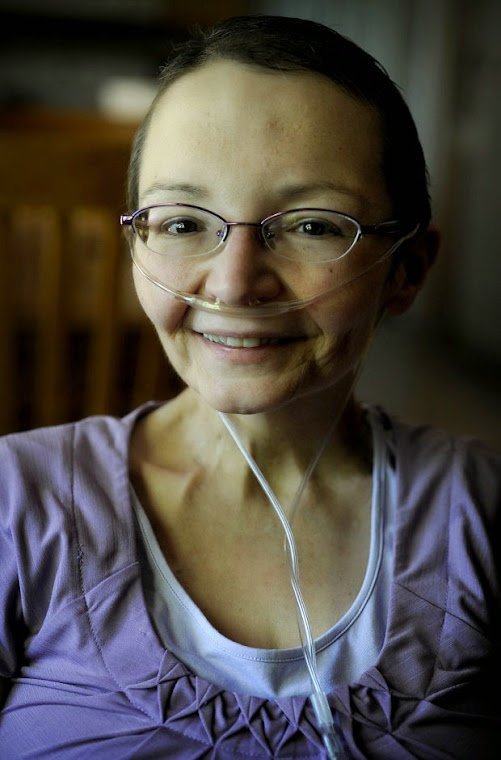
Daily Herald picture
Showing posts with label Adcetris. Show all posts
Showing posts with label Adcetris. Show all posts
Monday, December 30, 2013

Sunday, December 29, 2013
Waiting Is the Hardest Part
PET scan was complete on Thursday (12/26).
Dr. Breyer called me personally with the results of the last PET scan on Friday night about 6:00 pm. So I waited, hoping to hear the results of this scan, but no phone call.
It's okay. The scan will either show less cancer than last time, or no cancer.
But dealing with the "What ifs" that go with each scenario are the hardest part!!!!
And, if I'm being honest, my back is almost incessantly itchy again, just like it has been for the previous three Hodgkins occurrences. (I don't remember it itching when I was 7.) The itchiness is what clued me in that the Hodgkins was back after the aortic valve replacement, so that's not a good sign. I guess it's possible that the scan could show more cancer than last time because it's spread or the Adcetris has stopped being effective,
I make it through to Sunday night okay and am able to sleep pretty well. However, Sunday I have to watch an entire movie before I'm finally able to sleep around midnight.
We'll know in the morning!
Dr. Breyer called me personally with the results of the last PET scan on Friday night about 6:00 pm. So I waited, hoping to hear the results of this scan, but no phone call.
It's okay. The scan will either show less cancer than last time, or no cancer.
But dealing with the "What ifs" that go with each scenario are the hardest part!!!!
And, if I'm being honest, my back is almost incessantly itchy again, just like it has been for the previous three Hodgkins occurrences. (I don't remember it itching when I was 7.) The itchiness is what clued me in that the Hodgkins was back after the aortic valve replacement, so that's not a good sign. I guess it's possible that the scan could show more cancer than last time because it's spread or the Adcetris has stopped being effective,
I make it through to Sunday night okay and am able to sleep pretty well. However, Sunday I have to watch an entire movie before I'm finally able to sleep around midnight.
We'll know in the morning!
Thursday, December 26, 2013
PET Scan Time
It's almost rude.
It's 8:15 am the day after Christmas; and, once again, I'm forced to focus in on Hodgkins lymphoma. This time it's because I need to be at UVRMC in Provo by 8:45 for a PET scan.
After four doses of Adcetris (brentuximab vedontin), it's time to see if that chemo has done it's job.
I hate how you have to register at a kiosk, by typing in your last name, first name, birth month and day, and the department you need. Then wait in a reception area to register.
So what was that registration at the kiosk? And what was that phone call I answered about three days ago to pre-register?
I have to answer questions over the phone to pre-register, register at a kiosk, and then wait to register again for the final time?
Someone needs to fix this system!
It's also interesting to me that IHC hospitals require a finger poke to check liver function before they'll let you absorb contrast into your body. (To whine for a moment, I hate the finger pokes. I'd rather you draw my blood than poke my finger; a needle stick hurts less than the puncture wound.)
Plus, lately, it's not just a simple poke. They really have to jab deep because they're filling three pipettes (or small tubes) with blood. I know they're also testing blood glucose levels, but diabetic meters are all boasting how little blood they require these days--less than a drop.
So why three pipettes? Why the deep stab? Why the 2-3 minute process to "milk" my finger and squeeze all the blood you possibly can from the end of my nerve-damaged finger?
Luckily, the first part of the process goes fairly smoothly: access the port, inject the radioactive sugar, dim the lights and have me recline in a chair and wait 70 minutes while occasionally drinking about 16 oz. of oral contrast.
As I'm resting, I'm trying to count how many PET scans I have thus far in my life: at least 4-5 in the portable trailer at American Fork Hospital, at least 2 at Huntsman, one at the hospital off 5300 South in Salt Lake, and now this one at UVRMC. At least 8 total, and I'm pretty sure I'm forgetting at least two. Whew!
From all of those PET scans, I'm getting really good at judging how much time has passed while I'm resting and waiting for any cancerous lymph nodes in my body to absorb the radioactive sugar. Try it. If you're forced to rest in a dim room and do absolutely nothing but sit and wait, can you judge when 60-70 minutes are up?
Time for the CT and PET scans. Nothing new there either. Lay down on my back on a narrow hard table with my head in a strange foam pillow, arms above my head, stay absolutely still as the machine does 2-3 quick passes for the CT scan without contrast, then continue as the machine starts at my knees and spins about five minute, then moves to the next position (for a total of five different positions) until about 30 minutes have passed, then inject the IV contrast (that makes your lower abdomen feel very warm--like you've wet yourself) and wait for another 1-2 quick passes of the CT scan with contrast.
Ta-duh! Unhook the contrast tubing, flush the port, de-access the port, and you're now free to leave the premises with no hint as to any results.
Isn't modern medicine fun? lol
It's 8:15 am the day after Christmas; and, once again, I'm forced to focus in on Hodgkins lymphoma. This time it's because I need to be at UVRMC in Provo by 8:45 for a PET scan.
After four doses of Adcetris (brentuximab vedontin), it's time to see if that chemo has done it's job.
I hate how you have to register at a kiosk, by typing in your last name, first name, birth month and day, and the department you need. Then wait in a reception area to register.
So what was that registration at the kiosk? And what was that phone call I answered about three days ago to pre-register?
I have to answer questions over the phone to pre-register, register at a kiosk, and then wait to register again for the final time?
Someone needs to fix this system!
It's also interesting to me that IHC hospitals require a finger poke to check liver function before they'll let you absorb contrast into your body. (To whine for a moment, I hate the finger pokes. I'd rather you draw my blood than poke my finger; a needle stick hurts less than the puncture wound.)
Plus, lately, it's not just a simple poke. They really have to jab deep because they're filling three pipettes (or small tubes) with blood. I know they're also testing blood glucose levels, but diabetic meters are all boasting how little blood they require these days--less than a drop.
So why three pipettes? Why the deep stab? Why the 2-3 minute process to "milk" my finger and squeeze all the blood you possibly can from the end of my nerve-damaged finger?
Luckily, the first part of the process goes fairly smoothly: access the port, inject the radioactive sugar, dim the lights and have me recline in a chair and wait 70 minutes while occasionally drinking about 16 oz. of oral contrast.
As I'm resting, I'm trying to count how many PET scans I have thus far in my life: at least 4-5 in the portable trailer at American Fork Hospital, at least 2 at Huntsman, one at the hospital off 5300 South in Salt Lake, and now this one at UVRMC. At least 8 total, and I'm pretty sure I'm forgetting at least two. Whew!
From all of those PET scans, I'm getting really good at judging how much time has passed while I'm resting and waiting for any cancerous lymph nodes in my body to absorb the radioactive sugar. Try it. If you're forced to rest in a dim room and do absolutely nothing but sit and wait, can you judge when 60-70 minutes are up?
Time for the CT and PET scans. Nothing new there either. Lay down on my back on a narrow hard table with my head in a strange foam pillow, arms above my head, stay absolutely still as the machine does 2-3 quick passes for the CT scan without contrast, then continue as the machine starts at my knees and spins about five minute, then moves to the next position (for a total of five different positions) until about 30 minutes have passed, then inject the IV contrast (that makes your lower abdomen feel very warm--like you've wet yourself) and wait for another 1-2 quick passes of the CT scan with contrast.
Ta-duh! Unhook the contrast tubing, flush the port, de-access the port, and you're now free to leave the premises with no hint as to any results.
Isn't modern medicine fun? lol
Friday, April 5, 2013
Next, Next Step
Back to Dr. Wendy's office to find out the results of the recent PET scan.
I wonder what we'll find out, but I have absolutely no inspiration or feelings as to the results. It would be great if the cancer was totally gone, but either way it means radiation.
These are all the possibilities for this fourth occurrence of Hodgkins Lymphoma and their probable courses of action that I can come up with:
* It's gone, so we'll do follow up salvage radiation like we did before on my left inguinal lymph nodes.
* It's in one place only (right inguinal lymph node), so we'll do targeted radiation to remove it completed.
* It's in more than one place, so we'll continue chemo (for up to four more doses) as long as it's responding (shrinking) to the Adcetris.
Dr. Wendy reads part of the PET report to me. There's still lymphoma in my right inguinal lymph node. Originally, it measured over 19 on the activity level of the PET, now it's barely over 2. But there's no activity anywhere else.
Okay, no real surprises there. So all of the other eight spots that originally showed cancerous activity are gone. And the one remaining place is so, so close to being gone that chemo won't reach it anymore. So she's recommending me to Dr. Jay Clark for radiation treatments.
I don't know how those treatments will differ (if at all) from the salvage chemo I received last time, but that was easy with no side effects. Hopefully, it will be more of the same this time.
Oh wait. What about the possibility of a second bone marrow transplant, I ask. When should I follow up with the BMT team at LDS Hospital?
With a slightly surprised look, Dr. Wendy responds that I should probably consult with them before doing any radiation treatments because she doesn't want the radiation treatments to conflict with anything the BMT team wants to do. So wait to hear from LDS Hospital before scheduling with Dr. Jay.
Whew! It's a good thing that patients advocate for themselves and keep their doctors on track.
I wait to hear from Rachel Beers at LDS Hospital. She feels like one of my best friends by now after being the point of contact throughout the entire autologous bone marrow transplant process. She got a very terse message from Dr. Wendy's office and calls me for clarification. I'm able to clarify that the lymphoma is very close to being gone but needs radiation and we don't want to proceed with that step if it will interfere with the possibility of an allogeneic (from a donor) bone marrow transplant.
After checking with Dr. Julie Asch (another friend by this point of my life), she assures me that I can proceed with radiation.
I call Dr. Jay's office, only to find out that Corinne left early and forwarded all calls to, what seems like, an older female friend. That person isn't in the office and doesn't have access to the appointment books so now I have to wait for Monday to call. Annoying because I'm supposed to be covering for my team at work while they attend a conference in San Diego. I don't know whether to go to work on Monday to cover for my team or try and work from home with the hope that Dr. Jay can fit me in his schedule on Monday.
Why do health professionals have to take off before 4:30 p.m. on Friday without any way to get answers to pressing medical questions?
I wonder what we'll find out, but I have absolutely no inspiration or feelings as to the results. It would be great if the cancer was totally gone, but either way it means radiation.
These are all the possibilities for this fourth occurrence of Hodgkins Lymphoma and their probable courses of action that I can come up with:
* It's gone, so we'll do follow up salvage radiation like we did before on my left inguinal lymph nodes.
* It's in one place only (right inguinal lymph node), so we'll do targeted radiation to remove it completed.
* It's in more than one place, so we'll continue chemo (for up to four more doses) as long as it's responding (shrinking) to the Adcetris.
Dr. Wendy reads part of the PET report to me. There's still lymphoma in my right inguinal lymph node. Originally, it measured over 19 on the activity level of the PET, now it's barely over 2. But there's no activity anywhere else.
Okay, no real surprises there. So all of the other eight spots that originally showed cancerous activity are gone. And the one remaining place is so, so close to being gone that chemo won't reach it anymore. So she's recommending me to Dr. Jay Clark for radiation treatments.
I don't know how those treatments will differ (if at all) from the salvage chemo I received last time, but that was easy with no side effects. Hopefully, it will be more of the same this time.
Oh wait. What about the possibility of a second bone marrow transplant, I ask. When should I follow up with the BMT team at LDS Hospital?
With a slightly surprised look, Dr. Wendy responds that I should probably consult with them before doing any radiation treatments because she doesn't want the radiation treatments to conflict with anything the BMT team wants to do. So wait to hear from LDS Hospital before scheduling with Dr. Jay.
Whew! It's a good thing that patients advocate for themselves and keep their doctors on track.
I wait to hear from Rachel Beers at LDS Hospital. She feels like one of my best friends by now after being the point of contact throughout the entire autologous bone marrow transplant process. She got a very terse message from Dr. Wendy's office and calls me for clarification. I'm able to clarify that the lymphoma is very close to being gone but needs radiation and we don't want to proceed with that step if it will interfere with the possibility of an allogeneic (from a donor) bone marrow transplant.
After checking with Dr. Julie Asch (another friend by this point of my life), she assures me that I can proceed with radiation.
I call Dr. Jay's office, only to find out that Corinne left early and forwarded all calls to, what seems like, an older female friend. That person isn't in the office and doesn't have access to the appointment books so now I have to wait for Monday to call. Annoying because I'm supposed to be covering for my team at work while they attend a conference in San Diego. I don't know whether to go to work on Monday to cover for my team or try and work from home with the hope that Dr. Jay can fit me in his schedule on Monday.
Why do health professionals have to take off before 4:30 p.m. on Friday without any way to get answers to pressing medical questions?
Wednesday, April 3, 2013
Broken Ankle Follow Up
Dr. Garrett asked me to return for follow up x-rays on my left ankle about two weeks out, and it's been two and a half weeks, so I head back to Urgent Care in Lindon.
Dr. Garrett is out on Spring Break, but a nurse practitioner is available to see me, so I head back to x-ray to get follow up images.
I never asked what part of my ankle I broke, so I ask the technician if I can see my earlier x-rays to see what I broke. She needs to know what x-rays to do, so she pulls them up and the formal report from the radiologist who read the x-rays after I left Dr. Garrett a few weeks ago.
She pulls up the x-rays and shows me where an earlier break of my malleolus occurred. (The malleolus is the rounded bony prominence on the outside of each ankle.) She can tell it was an earlier break because the edges are all rounded and smooth--evidence of a healed broken bone. And she points out the sharp jagged lines of what Dr. Garrett assumed was where I broke it this time. It's a smaller break, about a quarter of the size and behind the earlier break.
She pulls up the radiologist's report and we read together that he notes the earlier break but doesn't see evidence of any other breaks.
Wait a minute? I've been clunking around in that stupid boot when I didn't need to? Forget that! I'm ready to be done with the walking boot. Hooray!
The technician doesn't want to subject me to more radiation for a non-break, so back to the waiting room I go to wait for the nurse practitioner. She's fast and a few minutes later we're discussing my foot. She's looked at the old x-rays and the radiologist's report and is absolutely convinced I have broken my ankle and doesn't really know how to explain the report--except that radiologist's in her opinion can't be trusted.
She proceeds to tell me about a violent pain she had in her stomach for a while ago, insisted upon CT scans, and read the radiologist's report that all was normal. She insisted on seeing the pictures herself and noted lots of fluid accumulation right where she was feeling the pain. Turns out she needed surgery but felt immediately better after the surgery.
I recounted my own recent experience of having a CT scan to track the progress of chemo in shrinking the tumor in my right inguinal lymph node and not having the radiologist even mention the lump in his report. Then having to have them go back into the scans, measure the area, and add an addendum to the original report with the new measurements.
I can understand how they might miss a small break if they miss measuring a tumor that we've been tracking for several months now and were asked to compare the size to previous scans that were done at the same place (Central Utah Clinic in American Fork).
So back to x-ray we go to compare old films to new films to see if it's healing. The malleolus is supposed to be one bone. It looks like the new break is healing but it's not healing or attaching itself to the malleolus; instead, it's a separate little disk of bone that's just out there by itself.
She asks if it's causing pain. (No, because I can't feel my feet due to the neuropathy.) And then suggests that I come back in another two and half weeks to ensure that it continues to heal. If it was causing me pain or making it more difficult to walk, she recommend surgery. However, it's hard to tell if it needs surgical intervention because walking is difficult anyway, and I can't feel my feet.
The comedy of errors that is my life--it isn't broken, but wait it really is--continues!
Dr. Garrett is out on Spring Break, but a nurse practitioner is available to see me, so I head back to x-ray to get follow up images.
I never asked what part of my ankle I broke, so I ask the technician if I can see my earlier x-rays to see what I broke. She needs to know what x-rays to do, so she pulls them up and the formal report from the radiologist who read the x-rays after I left Dr. Garrett a few weeks ago.
She pulls up the x-rays and shows me where an earlier break of my malleolus occurred. (The malleolus is the rounded bony prominence on the outside of each ankle.) She can tell it was an earlier break because the edges are all rounded and smooth--evidence of a healed broken bone. And she points out the sharp jagged lines of what Dr. Garrett assumed was where I broke it this time. It's a smaller break, about a quarter of the size and behind the earlier break.
She pulls up the radiologist's report and we read together that he notes the earlier break but doesn't see evidence of any other breaks.
Wait a minute? I've been clunking around in that stupid boot when I didn't need to? Forget that! I'm ready to be done with the walking boot. Hooray!
The technician doesn't want to subject me to more radiation for a non-break, so back to the waiting room I go to wait for the nurse practitioner. She's fast and a few minutes later we're discussing my foot. She's looked at the old x-rays and the radiologist's report and is absolutely convinced I have broken my ankle and doesn't really know how to explain the report--except that radiologist's in her opinion can't be trusted.
She proceeds to tell me about a violent pain she had in her stomach for a while ago, insisted upon CT scans, and read the radiologist's report that all was normal. She insisted on seeing the pictures herself and noted lots of fluid accumulation right where she was feeling the pain. Turns out she needed surgery but felt immediately better after the surgery.
I recounted my own recent experience of having a CT scan to track the progress of chemo in shrinking the tumor in my right inguinal lymph node and not having the radiologist even mention the lump in his report. Then having to have them go back into the scans, measure the area, and add an addendum to the original report with the new measurements.
I can understand how they might miss a small break if they miss measuring a tumor that we've been tracking for several months now and were asked to compare the size to previous scans that were done at the same place (Central Utah Clinic in American Fork).
So back to x-ray we go to compare old films to new films to see if it's healing. The malleolus is supposed to be one bone. It looks like the new break is healing but it's not healing or attaching itself to the malleolus; instead, it's a separate little disk of bone that's just out there by itself.
She asks if it's causing pain. (No, because I can't feel my feet due to the neuropathy.) And then suggests that I come back in another two and half weeks to ensure that it continues to heal. If it was causing me pain or making it more difficult to walk, she recommend surgery. However, it's hard to tell if it needs surgical intervention because walking is difficult anyway, and I can't feel my feet.
The comedy of errors that is my life--it isn't broken, but wait it really is--continues!
Monday, April 1, 2013
PET Scan
I was too sick with bronchitis last Thursday when the PET scan was originally scheduled, so it's rescheduled for today at 12:30 p.m. at Huntsman Cancer Institute.
It's a beautiful building with amazing materials and gorgeous stone that high on the mountainside behind Primary Childrens and the University of Utah hospitals. Just walking in seems like entering a place of authority that knows what it's doing and calm assurance.
I get to third floor radiology and am almost immediately taken back for the PET scan.
Whoops, but my port isn't accessed and the technicians haven't been trained how to access ports. Weird, because I swear that last time, they accessed it okay.
But they have to find someone else that can access ports, so I'm wheeled off to mammography or the breast health department (trying to balance a large oxygen tank and it's cart on top of the arm rests) that's just down the hallway.
I'm amazed to watch as the nurse in the lab has to use sterile technique to access the port and even comment about it. It's interesting to see the different protocols that different medical facilities use, because Dr. Wendy's clinic (which is part of Huntsman Cancer Institute) doesn't use sterile technique, just a fresh pair of gloves to access my port.
The port is successfully accessed, so I'm wheeled back to radiology where the radioactive isotope is injected and the long waiting period begins.
The lights are dimmed, I'm covered with two warm blankets, and I proceed to rest quietly (without moving) for 75 minutes. I'm getting pretty good at accounting for the passage of time because just about when I think it's been 75 minutes, the doors open and I'm whisked off to the CT/PET machine.
No oral or IV contrast, and the scans are complete in about 35 minutes.
I'm free for the rest of the day. Well, as free as I can be with a walking boot on my left foot and dragging a large oxygen tank and its cart behind me. I even manage to snag a fun size Twix bar from the valet attendants that's left over from Easter (because I've been fasting since 6 a.m. and it's now after 3:00 p.m.).
Now to drive back home.
It's a beautiful building with amazing materials and gorgeous stone that high on the mountainside behind Primary Childrens and the University of Utah hospitals. Just walking in seems like entering a place of authority that knows what it's doing and calm assurance.
I get to third floor radiology and am almost immediately taken back for the PET scan.
Whoops, but my port isn't accessed and the technicians haven't been trained how to access ports. Weird, because I swear that last time, they accessed it okay.
But they have to find someone else that can access ports, so I'm wheeled off to mammography or the breast health department (trying to balance a large oxygen tank and it's cart on top of the arm rests) that's just down the hallway.
I'm amazed to watch as the nurse in the lab has to use sterile technique to access the port and even comment about it. It's interesting to see the different protocols that different medical facilities use, because Dr. Wendy's clinic (which is part of Huntsman Cancer Institute) doesn't use sterile technique, just a fresh pair of gloves to access my port.
The port is successfully accessed, so I'm wheeled back to radiology where the radioactive isotope is injected and the long waiting period begins.
The lights are dimmed, I'm covered with two warm blankets, and I proceed to rest quietly (without moving) for 75 minutes. I'm getting pretty good at accounting for the passage of time because just about when I think it's been 75 minutes, the doors open and I'm whisked off to the CT/PET machine.
No oral or IV contrast, and the scans are complete in about 35 minutes.
I'm free for the rest of the day. Well, as free as I can be with a walking boot on my left foot and dragging a large oxygen tank and its cart behind me. I even manage to snag a fun size Twix bar from the valet attendants that's left over from Easter (because I've been fasting since 6 a.m. and it's now after 3:00 p.m.).
Now to drive back home.
Tuesday, March 26, 2013
Next Step
So where are we at now?
I meet with Dr. Wendy again to see what the recent CT scan showed.
And it doesn't seem like the one tumor we know about is changing much. It's probably too small for the chemo to accurately target it.
"So now get a PET scan and see what we're dealing with," I add.
And immediately, I'm harassed by Dr. Wendy. "Why do all of my patients today like to second guess me without listening to me."
"Well, it's not like any of this is a surprise to me. We've been down this road several times together," I remind her. That seems to mollify her.
Okay, so no chemo today. Instead, I'll wait for a PET scan to be scheduled at Huntsman Cancer Institute in Salt Lake City again.
I meet with Dr. Wendy again to see what the recent CT scan showed.
And it doesn't seem like the one tumor we know about is changing much. It's probably too small for the chemo to accurately target it.
"So now get a PET scan and see what we're dealing with," I add.
And immediately, I'm harassed by Dr. Wendy. "Why do all of my patients today like to second guess me without listening to me."
"Well, it's not like any of this is a surprise to me. We've been down this road several times together," I remind her. That seems to mollify her.
Okay, so no chemo today. Instead, I'll wait for a PET scan to be scheduled at Huntsman Cancer Institute in Salt Lake City again.
Wednesday, March 20, 2013
CT Scans and Contrast
It's the day before my CT scan is scheduled, so I have to pick up oral contrast to drink tonight and tomorrow morning before the scan.
On my drive over to Central Utah Clinic's (CUC) Imaging Department, I start thinking about all of the radiologic scans I've had for cancer over the years, lymphangiograms, CT scans, PET scans. I'll bet the numbers are starting to approach 100 (or at least it feels that way to me). That's a lot of contrast that my body has had to deal with.
Every time I have a scan, the technologists seem surprised that I'm not diabetic yet, like my body (pancreas, kidneys, and liver mostly) hasn't started refusing to work properly because of everything it's been subject to so far.
Actually, now that I'm thinking about it, it seems like I was told in the last month or so that my liver enzymes weren't quite normal in a recent blood count and I should start watching that.
Now, I'm a little paranoid about the amount of contrast that I've been pouring into my body; and I'm on the way to pick up two more bottles of the stuff? Not to mention the IV contrast they'll also shoot through my port?
And there's no accounting for body type or size in the contrast they hand you. "CT Scan of the abdomen? Here, drink these two bottles." It didn't matter if I had the scans done when I weighed 231 pounds or now that I'm down to 164 pounds. They want me to pour the same amount of junk into my body and let my kidneys and liver fight to filter it out. That just doesn't seem right.
I arrive at the Imaging Department a little ticked off at Central Utah Clinic's protocols. Huntsman Cancer Institute in Salt Lake City doesn't use any contrast--oral or IV--for PET scans, which are even more detailed than CT scans, because their radiologists have realized the contrast doesn't improve the quality of the pictures enough to justify the potential havoc it can wreak on already-weakened bodies.
So I ask to speak to the radiologist at CUC. Surely, they've got to give some on the amount of contrast they demand when considering my body and all it's been through.
I'm politely told that the radiologist is in a procedure with another patient and they don't usually talk to patients anyway. It's okay. I'm determined. I'll wait. Exasperated by my stubbornness to be heard, the receptionist goes to find a technician that will talk to me. I can hear part of their interchange as I wait at the desk.
"I'll go talk to her. The radiologist is busy."
"Yeah, good luck with that."
So I start telling the technologist that I'm worried about pouring more contrast into my body when it's obviously been through so much already, and that there's no consideration for body type or mass taken into account when handing out contrast.
"You're a male, professional defensive linebacker who's 6'5" and 350 pounds? Great. Drink these two bottles of contrast." "You're a female cancer patient who's 5'0" and 164 pounds? Great. Drink these two bottles of contrast."
Then, and only then am I offered a different style of contrast. One that doesn't take the body 4-5 days to break down, just a couple hours, and one that doesn't have any known side affects or possibility of damaging bodies. I just need to arrive tomorrow morning an hour earlier so I can drink it in the office.
Why aren't patients made aware of the choices they have unless they really push back--hard!--at what's being asked of them?
I arrive the next morning an hour earlier and am asked to drink about half of the volume of what those two bottles of contrast contained. I still leave about a swallowful of the new contrast in the bottom of the glass, just on principle! But I'm pleasantly surprised to find that this new contrast tastes much better. No chalky, milky stuff that I'm afraid my body is conditioned to gag on by now. Instead, it's almost a translucent tart substance.
So I didn't convince them not to give my any contrast, but at least we found a less dangerous and less volume (that still isn't based on my body type or size) compromise.
It pays to speak up and advocate for yourself!
On my drive over to Central Utah Clinic's (CUC) Imaging Department, I start thinking about all of the radiologic scans I've had for cancer over the years, lymphangiograms, CT scans, PET scans. I'll bet the numbers are starting to approach 100 (or at least it feels that way to me). That's a lot of contrast that my body has had to deal with.
Every time I have a scan, the technologists seem surprised that I'm not diabetic yet, like my body (pancreas, kidneys, and liver mostly) hasn't started refusing to work properly because of everything it's been subject to so far.
Actually, now that I'm thinking about it, it seems like I was told in the last month or so that my liver enzymes weren't quite normal in a recent blood count and I should start watching that.
Now, I'm a little paranoid about the amount of contrast that I've been pouring into my body; and I'm on the way to pick up two more bottles of the stuff? Not to mention the IV contrast they'll also shoot through my port?
And there's no accounting for body type or size in the contrast they hand you. "CT Scan of the abdomen? Here, drink these two bottles." It didn't matter if I had the scans done when I weighed 231 pounds or now that I'm down to 164 pounds. They want me to pour the same amount of junk into my body and let my kidneys and liver fight to filter it out. That just doesn't seem right.
I arrive at the Imaging Department a little ticked off at Central Utah Clinic's protocols. Huntsman Cancer Institute in Salt Lake City doesn't use any contrast--oral or IV--for PET scans, which are even more detailed than CT scans, because their radiologists have realized the contrast doesn't improve the quality of the pictures enough to justify the potential havoc it can wreak on already-weakened bodies.
So I ask to speak to the radiologist at CUC. Surely, they've got to give some on the amount of contrast they demand when considering my body and all it's been through.
I'm politely told that the radiologist is in a procedure with another patient and they don't usually talk to patients anyway. It's okay. I'm determined. I'll wait. Exasperated by my stubbornness to be heard, the receptionist goes to find a technician that will talk to me. I can hear part of their interchange as I wait at the desk.
"I'll go talk to her. The radiologist is busy."
"Yeah, good luck with that."
So I start telling the technologist that I'm worried about pouring more contrast into my body when it's obviously been through so much already, and that there's no consideration for body type or mass taken into account when handing out contrast.
"You're a male, professional defensive linebacker who's 6'5" and 350 pounds? Great. Drink these two bottles of contrast." "You're a female cancer patient who's 5'0" and 164 pounds? Great. Drink these two bottles of contrast."
Then, and only then am I offered a different style of contrast. One that doesn't take the body 4-5 days to break down, just a couple hours, and one that doesn't have any known side affects or possibility of damaging bodies. I just need to arrive tomorrow morning an hour earlier so I can drink it in the office.
Why aren't patients made aware of the choices they have unless they really push back--hard!--at what's being asked of them?
I arrive the next morning an hour earlier and am asked to drink about half of the volume of what those two bottles of contrast contained. I still leave about a swallowful of the new contrast in the bottom of the glass, just on principle! But I'm pleasantly surprised to find that this new contrast tastes much better. No chalky, milky stuff that I'm afraid my body is conditioned to gag on by now. Instead, it's almost a translucent tart substance.
So I didn't convince them not to give my any contrast, but at least we found a less dangerous and less volume (that still isn't based on my body type or size) compromise.
It pays to speak up and advocate for yourself!
Monday, March 18, 2013
Another Hiccup
So maybe I don't make the best choices sometimes.
It's Sunday, St. Patrick's Day, and I want to wear a pair of green wedge platforms for the holiday. I took trial run with them Saturday night to the adult session of Stake Conference. They're not heels where I'm forced to try and balance on the soles of my feet only and they're only about a 2.5" platform, so I figure it's safe to proceed
We have about ten minutes before we have to leave Sunday morning. Everyone's ready or finishing their preparations, so I head back to the closet to grab my green platforms. Before I make it out of our bathroom, I've managed to roll my left ankle pretty severely and even cry out from the pain and the suddenness of being so off balance; but I'm determined to proceed.
I make it out to our living room where Dale, Miriam, Travis, my sister Tressie, her two daughters Karli and Kayla, and some other girls are waiting for us to leave. Before I've moved two steps from the edge of our couch, I roll my ankle twice more, with Dale having to reach out and catch me the last time.
Without missing a beat, he asks "What flats should I go get you?" and he kicks that pretty green platform right off my left foot.
Darn! I guess you shouldn't try to wear platform shoes when you can't feel your feet. If you can't walk or balance in regular shoes, any type of heel probably isn't the best decision.
We make it to Stake Conference and are ushered to the front so that Dale, Tressie, and I can sit together at the end of a row (while Miriam, Travis, and the rest of the girls get to sit in the back). Travis is carrying my bag, so it goes back with them without me realizing that I don't have it.
Almost as soon as I sit down, my foot starts throbbing. It's not so painful, but I can feel every heartbeat vibrating through it and there is a little pain associated with each beat.
"Dale, I think I need to go out and prop my foot up," I whisper to him. So a few minutes later, I'm hobbling on one good foot and dragging a large oxygen tank and its cart out the chapel doors to the nearest couch.
Tressie comes out a few seconds later and offers to drag a folding chair over as a place to prop up my foot and that's how we spend Stake Conference.
On Monday, my foot is a little swollen and a little bruised and I wonder how much damage I really did to it. Because I can't really feel it, is it possible I broke it and don't know?
Knowing my propensity for having multiple issues with my body, I head off to Urgent Care in Lindon.
"I need to have my left ankle x-rayed to ensure that I didn't break it," I inform the front desk staff and the attending nurse. I'm assured that I'm the next patient and that the doctor will be with me shortly.
After what seems like an hour and after I've had a chance to devour an entire magazine, I hobble out to find my sheet on the door and look at the time I was checked in. 11:08 a.m. It's now 12:06 p.m., so it has been an hour. I'm kind of surprised that my internal clock is so accurate.
When I ask the nurses how much longer, they agree it's been too long and they'll take me back for x-rays before the doctor sees me so he can look at them when he's finally finished with the other patient.
About ten minutes later, after x-rays, Dr. Garrett Smith comes in and says, "Yeah, well you did a good job. I'm pretty sure your ankle is broken. You'll need to be on crutches for at least two weeks."
Knowing what my body has been through and that chemo zaps calcium from bones, I automatically translate, "Okay for me, that means at least four weeks and probably more like six." Then I say, "Yeah, well as soon as you help me figure out how to hobble on crutches while dragging oxygen around, I'm all over your plan." Crutches are just not going to work.
During our conversation, I tell him that I can't really feel my feet due to the grade 3 or 4 peripheral neuropathy. Yet twice during our time together, he says "Just let pain be your guide. If it's hurts, don't walk on it" and "I can prescribe something for pain."
Pain? What pain? If I think about it hard, there might be some aching bone pain that might register about a 3 on the 1-10 usual pain scale. I'm certainly not taking anything (not even Ibuprofen) for a 3. And if I can walk on it as long as it doesn't hurt, I'm good to go now.
Nope, not without having to discuss whether we should cast it or put a walking boot on my left foot.
"What's the easiest to walk on?" I ask. Definitely the walking boot, so I'm fitted with a large, clunky, heavy black boot before managing to leave the office.
My life is a comedy of errors at this point. Hobbling around in a heavy walking boot and dragging oxygen is quite the balancing act, without bringing the numbness from the neuropathy into the equation. What else can I do at this point but just laugh? And laugh I do!
When one of my visiting teachers hears that I've broken my ankle, her first impression is to bring her family home from Disneyland so she can help me. Are you kidding? It's a great thought, but my ankle is just another silly part of my life right now. It's not like I need surgery or it's bad enough that I can't be mobile. It's just a laughable addition to my life at this point. The thought is comforting and amazing but definitely not needed!
It's Sunday, St. Patrick's Day, and I want to wear a pair of green wedge platforms for the holiday. I took trial run with them Saturday night to the adult session of Stake Conference. They're not heels where I'm forced to try and balance on the soles of my feet only and they're only about a 2.5" platform, so I figure it's safe to proceed
We have about ten minutes before we have to leave Sunday morning. Everyone's ready or finishing their preparations, so I head back to the closet to grab my green platforms. Before I make it out of our bathroom, I've managed to roll my left ankle pretty severely and even cry out from the pain and the suddenness of being so off balance; but I'm determined to proceed.
I make it out to our living room where Dale, Miriam, Travis, my sister Tressie, her two daughters Karli and Kayla, and some other girls are waiting for us to leave. Before I've moved two steps from the edge of our couch, I roll my ankle twice more, with Dale having to reach out and catch me the last time.
Without missing a beat, he asks "What flats should I go get you?" and he kicks that pretty green platform right off my left foot.
Darn! I guess you shouldn't try to wear platform shoes when you can't feel your feet. If you can't walk or balance in regular shoes, any type of heel probably isn't the best decision.
We make it to Stake Conference and are ushered to the front so that Dale, Tressie, and I can sit together at the end of a row (while Miriam, Travis, and the rest of the girls get to sit in the back). Travis is carrying my bag, so it goes back with them without me realizing that I don't have it.
Almost as soon as I sit down, my foot starts throbbing. It's not so painful, but I can feel every heartbeat vibrating through it and there is a little pain associated with each beat.
"Dale, I think I need to go out and prop my foot up," I whisper to him. So a few minutes later, I'm hobbling on one good foot and dragging a large oxygen tank and its cart out the chapel doors to the nearest couch.
Tressie comes out a few seconds later and offers to drag a folding chair over as a place to prop up my foot and that's how we spend Stake Conference.
On Monday, my foot is a little swollen and a little bruised and I wonder how much damage I really did to it. Because I can't really feel it, is it possible I broke it and don't know?
Knowing my propensity for having multiple issues with my body, I head off to Urgent Care in Lindon.
"I need to have my left ankle x-rayed to ensure that I didn't break it," I inform the front desk staff and the attending nurse. I'm assured that I'm the next patient and that the doctor will be with me shortly.
After what seems like an hour and after I've had a chance to devour an entire magazine, I hobble out to find my sheet on the door and look at the time I was checked in. 11:08 a.m. It's now 12:06 p.m., so it has been an hour. I'm kind of surprised that my internal clock is so accurate.
When I ask the nurses how much longer, they agree it's been too long and they'll take me back for x-rays before the doctor sees me so he can look at them when he's finally finished with the other patient.
About ten minutes later, after x-rays, Dr. Garrett Smith comes in and says, "Yeah, well you did a good job. I'm pretty sure your ankle is broken. You'll need to be on crutches for at least two weeks."
Knowing what my body has been through and that chemo zaps calcium from bones, I automatically translate, "Okay for me, that means at least four weeks and probably more like six." Then I say, "Yeah, well as soon as you help me figure out how to hobble on crutches while dragging oxygen around, I'm all over your plan." Crutches are just not going to work.
During our conversation, I tell him that I can't really feel my feet due to the grade 3 or 4 peripheral neuropathy. Yet twice during our time together, he says "Just let pain be your guide. If it's hurts, don't walk on it" and "I can prescribe something for pain."
Pain? What pain? If I think about it hard, there might be some aching bone pain that might register about a 3 on the 1-10 usual pain scale. I'm certainly not taking anything (not even Ibuprofen) for a 3. And if I can walk on it as long as it doesn't hurt, I'm good to go now.
Nope, not without having to discuss whether we should cast it or put a walking boot on my left foot.
"What's the easiest to walk on?" I ask. Definitely the walking boot, so I'm fitted with a large, clunky, heavy black boot before managing to leave the office.
My life is a comedy of errors at this point. Hobbling around in a heavy walking boot and dragging oxygen is quite the balancing act, without bringing the numbness from the neuropathy into the equation. What else can I do at this point but just laugh? And laugh I do!
When one of my visiting teachers hears that I've broken my ankle, her first impression is to bring her family home from Disneyland so she can help me. Are you kidding? It's a great thought, but my ankle is just another silly part of my life right now. It's not like I need surgery or it's bad enough that I can't be mobile. It's just a laughable addition to my life at this point. The thought is comforting and amazing but definitely not needed!
Tuesday, March 5, 2013
Tenth (and Last!) Adcetris Dose
You can tell that Dr. Wendy is consulting with others about my case in between my treatments. Today, she has an entirely new plan.
We'll go ahead with today's dose of Adcetris, then get a CT scan to see where the tumor is at. It seems chemo isn't as effective at reaching cancerous tumors once they're smaller than about a centimeter, so we might have to do radiation to get rid of it entirely.
No real changes with chemo. It's just business as usual, so we'll wait to see what the CT scan shows.
We'll go ahead with today's dose of Adcetris, then get a CT scan to see where the tumor is at. It seems chemo isn't as effective at reaching cancerous tumors once they're smaller than about a centimeter, so we might have to do radiation to get rid of it entirely.
No real changes with chemo. It's just business as usual, so we'll wait to see what the CT scan shows.
Wednesday, February 13, 2013
Ninth Adcetris Dose
There's not much to tell.
We keep doing chemo. The affects are pretty well managed now, but I'm starting to feel sick from some kind of sinus infection, so Dr. Wendy gives me a prescription for an antibiotic, one I've not heard of before--Keflex.
The peripheral neuropathy seems to be increasing, but maybe it's because I'm more aware of it in my arms and legs now. Like, my legs are numb about halfway up my thighs now and especially on the insides of the knees.
The plan is to do twelve doses of Adcetris total. That's just two more after today. The tumor keeps shrinking and is almost gone, so that should take care of it. We'll do a CT scan, then wait about a month and do a PET scan and see where we're at.
Life keeps marching on, and I'm definitely still kicking!
We keep doing chemo. The affects are pretty well managed now, but I'm starting to feel sick from some kind of sinus infection, so Dr. Wendy gives me a prescription for an antibiotic, one I've not heard of before--Keflex.
The peripheral neuropathy seems to be increasing, but maybe it's because I'm more aware of it in my arms and legs now. Like, my legs are numb about halfway up my thighs now and especially on the insides of the knees.
The plan is to do twelve doses of Adcetris total. That's just two more after today. The tumor keeps shrinking and is almost gone, so that should take care of it. We'll do a CT scan, then wait about a month and do a PET scan and see where we're at.
Life keeps marching on, and I'm definitely still kicking!
Wednesday, January 23, 2013
Eighth Adcetris Dose
At least halfway through chemo after today. 8/16 or halfway through the maximum amount of Adcetris doses allowed.
If it continues as well as it has been and the peripheral neuropathy eases up, the rest of the doses should be no problem.
Although, if I'm honest, ever since my last appointment and the fact that Dr. Wendy can no longer feel the largest tumor, my hope is that we'll schedule scans in the next three weeks (normal procedure after every two doses, so it's time again), and those scans will show no more cancer.
Not a lot to report today, although I do think the peripheral neuropathy in my hands is slightly better. It's a little easier to write longhand and to type. I can tell because I'm not watching my fingers or using the Backspace key as often. But my balance actually seems worse lately and I can't tell that there's any improvement in my feet and legs. Darn!
Dr. Wendy sounds disappointed that I haven't seen a bigger improvement, but she's grateful that it's not getting worse so we'll continue the reduced dosage.
Visit with Dr. Wendy, draw blood work, three anti-nausea medications, Adcetris, and two hours later I'm out of there.
A CT/CAT scan is scheduled for Monday, February 11. Hopefully, it's great news--no more cancer; and we can be done with Adcetris for at least 7-10 more years. That's what I'm hoping for and what would qualify for "this treatment exceeding all expectations."
If it continues as well as it has been and the peripheral neuropathy eases up, the rest of the doses should be no problem.
Although, if I'm honest, ever since my last appointment and the fact that Dr. Wendy can no longer feel the largest tumor, my hope is that we'll schedule scans in the next three weeks (normal procedure after every two doses, so it's time again), and those scans will show no more cancer.
Not a lot to report today, although I do think the peripheral neuropathy in my hands is slightly better. It's a little easier to write longhand and to type. I can tell because I'm not watching my fingers or using the Backspace key as often. But my balance actually seems worse lately and I can't tell that there's any improvement in my feet and legs. Darn!
Dr. Wendy sounds disappointed that I haven't seen a bigger improvement, but she's grateful that it's not getting worse so we'll continue the reduced dosage.
Visit with Dr. Wendy, draw blood work, three anti-nausea medications, Adcetris, and two hours later I'm out of there.
A CT/CAT scan is scheduled for Monday, February 11. Hopefully, it's great news--no more cancer; and we can be done with Adcetris for at least 7-10 more years. That's what I'm hoping for and what would qualify for "this treatment exceeding all expectations."
Sunday, January 6, 2013
Fast and Testimony Meeting
During the prelude music and start of Sacrament Meeting, I'm contemplating on how good I feel for going through my fifth regimen of chemo. And I realize that my rather foreign pessimistic outlook of late is gone. I no longer feel so dark inside, like I'm fighting a losing battle. Sure, the next instance might kill me, but I might have a long time before the lymphoma is back. I have hope again. These are truly amazing discoveries!
And, as usual, I start scanning the congregation and reflecting on how many individuals in our ward that I feel truly supported by. I love these people and there's way too many to list.
A few things definitely stand out though: purple flowers planted in our flower beds by the Mia Maids, a large container filled with purple flowers from Jana, purple flowers and a cuddly blanket from Sandy, a very touching note from John and an equally touching post/email from Jennifer, and a beautiful chest of notes from lots of people and delivered by Maddie on a night when everything seemed really black and hopeless.
Suddenly, I'm overwhelmed by all of the love and support that I feel. All of those prayers are why this regimen is treating me so well so far. I know it. It's a great tender and miraculous mercy from our ward members who are definitely acting as the Savior's hands here on the earth.
Thank you all. I'm truly touched and grateful!
And, as usual, I start scanning the congregation and reflecting on how many individuals in our ward that I feel truly supported by. I love these people and there's way too many to list.
A few things definitely stand out though: purple flowers planted in our flower beds by the Mia Maids, a large container filled with purple flowers from Jana, purple flowers and a cuddly blanket from Sandy, a very touching note from John and an equally touching post/email from Jennifer, and a beautiful chest of notes from lots of people and delivered by Maddie on a night when everything seemed really black and hopeless.
Suddenly, I'm overwhelmed by all of the love and support that I feel. All of those prayers are why this regimen is treating me so well so far. I know it. It's a great tender and miraculous mercy from our ward members who are definitely acting as the Savior's hands here on the earth.
Thank you all. I'm truly touched and grateful!
Wednesday, January 2, 2013
Seventh Adcetris Dose
Dr. Wendy can no longer feel the largest tumor at the bend of my right leg. Wow! Wouldn't that be awesome if the cancer is gone!
I've lost 13 pounds since the last dose. That's just over 60 pounds total over the last nine months. Yahoo! I want to lose at least 15 pounds so I'm no longer in the obese BMI category. Dr. Wendy is concerned, but I've been eating well so I'm just grateful.
We have a longish conversation about peripheral neuropathy though. I'm not happy about that. I describe some of the limitations I've noticed:
* Fingers are completely numb and my hands are at least 3/4 numb.
* Forearms are at least 1/2 numb up to my elbow.
* Feet are at least 3/4 numb.
* Legs are at least 1/2 numb to the bottom of my knee.
* Typing is very difficult and I often hit the wrong key. Backspace is now my best friend.
* I can't play the piano or organ any more without having to watch my hands to see what keys I'm playing, plus I can't control that they continue to hold any keys so they randomly lift and quit playing at odd times on the organ.
* My handwriting has changed drastically and now reminds me of an 80 year-old woman's handwriting because it's difficult to hold a writing utensil and control the strokes.
* I can't button blouses or jeans or feel zippers to pull them up.
* Hooking my bra is impossible.
* Putting in earrings and--even more difficult--putting on their backs is now impossible.
* It's hard to walk in flats. Forget heels entirely!
* Balancing is almost impossible on dry ground. I fell in Target and have almost fallen twice at work. Didn't trip on anything; I just can't feel my feet to place each step securely and firmly.
After leaving the room for a few minutes, Dr. Wendy returns to say I have peripheral neuropathy, Grade 2 or 3. The guidelines for Adcetris call for stopping chemo until Grade 1 returns.
I'm not comfortable with that. These affects can be permanent. What if we never get back to Grade 1? After some discussion, she agrees to continue Adcetris, but on a reduced doseage. We will reduce the 1.8 unit/kg to 1.2 unit/kg. I don't like that we're reducing the dose by a full third, but at least we're continuing forward.
Do you know what else I've noticed? The doses are getting easier. What's up with that? In my entire history of chemo, every dose gets harder and harder--zapping almost all of my physical and emotional energy. Plus, every different chemo regimen gets harder and harder for my body because of all the former rounds (MOPP, ADV, ICE, BEAM, and now Adcetris) and poisons doctors pumped into it.
Not now. In fact, I've even started driving in to work 2-3 times a week. Wow! I'm am definitely not complaining. I have energy to do whatever I want (as long as I don't try to move my numb feet too fast) and I'm mentally alert as well.
The nausea is contained. The bone pain is being managed. This is great! More than I ever dared to hope or plan for. Hooray!
I've lost 13 pounds since the last dose. That's just over 60 pounds total over the last nine months. Yahoo! I want to lose at least 15 pounds so I'm no longer in the obese BMI category. Dr. Wendy is concerned, but I've been eating well so I'm just grateful.
We have a longish conversation about peripheral neuropathy though. I'm not happy about that. I describe some of the limitations I've noticed:
* Fingers are completely numb and my hands are at least 3/4 numb.
* Forearms are at least 1/2 numb up to my elbow.
* Feet are at least 3/4 numb.
* Legs are at least 1/2 numb to the bottom of my knee.
* Typing is very difficult and I often hit the wrong key. Backspace is now my best friend.
* I can't play the piano or organ any more without having to watch my hands to see what keys I'm playing, plus I can't control that they continue to hold any keys so they randomly lift and quit playing at odd times on the organ.
* My handwriting has changed drastically and now reminds me of an 80 year-old woman's handwriting because it's difficult to hold a writing utensil and control the strokes.
* I can't button blouses or jeans or feel zippers to pull them up.
* Hooking my bra is impossible.
* Putting in earrings and--even more difficult--putting on their backs is now impossible.
* It's hard to walk in flats. Forget heels entirely!
* Balancing is almost impossible on dry ground. I fell in Target and have almost fallen twice at work. Didn't trip on anything; I just can't feel my feet to place each step securely and firmly.
After leaving the room for a few minutes, Dr. Wendy returns to say I have peripheral neuropathy, Grade 2 or 3. The guidelines for Adcetris call for stopping chemo until Grade 1 returns.
I'm not comfortable with that. These affects can be permanent. What if we never get back to Grade 1? After some discussion, she agrees to continue Adcetris, but on a reduced doseage. We will reduce the 1.8 unit/kg to 1.2 unit/kg. I don't like that we're reducing the dose by a full third, but at least we're continuing forward.
Do you know what else I've noticed? The doses are getting easier. What's up with that? In my entire history of chemo, every dose gets harder and harder--zapping almost all of my physical and emotional energy. Plus, every different chemo regimen gets harder and harder for my body because of all the former rounds (MOPP, ADV, ICE, BEAM, and now Adcetris) and poisons doctors pumped into it.
Not now. In fact, I've even started driving in to work 2-3 times a week. Wow! I'm am definitely not complaining. I have energy to do whatever I want (as long as I don't try to move my numb feet too fast) and I'm mentally alert as well.
The nausea is contained. The bone pain is being managed. This is great! More than I ever dared to hope or plan for. Hooray!
Friday, December 28, 2012
Nieces and Nephews
Christopher, my oldest biological nephew, is serving in the Tampa, Florida mission. His next youngest brother, Clark, is expecting his own mission call on either Wednesday, December 26th or Thursday, December 27, so we all head down to St. George to watch him open his call, participate in his ordination as an elder, and attend his endowment session on Saturday.
It's going to be fun spending a few days with extended family over New Years.
Clark's call didn't come on Wednesday (kind of expected with the Christmas holiday), so we hustle down to St. George on Thursday to ensure we're there by 7 pm for the opening. But it doesn't come. Drat! We'll have to try again on Friday and pray that it really comes.
Friday, Dale and I run a few errands and arrive back at the Farnsworths just around lunch time. My observant husband notices that the mailperson is parked in front of the mailbox stack, so I run into the house to see if Cliff or Tressie are home. Cliff is but he doesn't have the mail key.
"It's okay. The mailperson is there now. Maybe if you show them your driver's license to prove your address, she'll give you your mail."
A few moments later, Cliff triumphantly waves a large white envelope from the Church of Jesus Christ of Latter-Day Saints bearing Clark's name. It's going to be a busy couple of hours for Clark.
At 6:45, he meets with his bishop at the house, in the basement by the pool table for his living ordinance temple recommend. (It's the quietest place in the building because there's so many extended family members and friends there.)
At 7:00, Clark opens his call to the Independence, Missouri--Spanish speaking mission. He reports to the MTC on March 6th. Not much time to get ready. Chris even got special permission to join by Skype so that he could participate.
At 7:45, Clark leaves his own party to meet with his Stake President for a living ordinance temple interview.
At 8:00, he's ordained at the Stake Center to the Melchezidik Priesthood, office of an Elder.
By 9:10 tomorrow morning, he needs to be at the St. George temple to receive his own endowments.
Whew! I'm exhausted, which might explain why I feel like torturing Bailey, my youngest niece and the one who can entertain me and make me laugh the most at not-quite-two-years-old.
So, when we're all sure that Bailey is paying attention, someone pulls my oxygen cord apart into two separate pieces and I immediately slump and slink down as if I've been unplugged and am now dead. Bailey is immediately concerned and makes motions to reconnect the cord and wake me up again. Ah, I can breathe again and magically come to life.
We replay the scene at various times over the weekend, but Bailey doesn't want anything more to do with it. If anyone picks up my cord and threatens to disconnect me, she waves her hands in front of her, saying "No, No, No" as she runs out of the room. It's good to know she cares about me so much.
Finally, after torturing her several times and joking that she's going to be traumatized for life, I hit upon something that might help her feel better about my oxygen cord. So, I arrange for my cord to be disconnected while I slump dead again and deliberately place the two parts of the oxygen cord at her eye level so that she'll "accidentally" discover it as another niece guides her over to me.
"Oh no, Bailey. What happened to Trisha? Can you plug her in again? Good job, she's plugged in."
And, once again, I'm magically healed and sitting up, and Bailey got to heal me. She feels much better about that than watching me slump over.
It's going to be fun spending a few days with extended family over New Years.
Clark's call didn't come on Wednesday (kind of expected with the Christmas holiday), so we hustle down to St. George on Thursday to ensure we're there by 7 pm for the opening. But it doesn't come. Drat! We'll have to try again on Friday and pray that it really comes.
Friday, Dale and I run a few errands and arrive back at the Farnsworths just around lunch time. My observant husband notices that the mailperson is parked in front of the mailbox stack, so I run into the house to see if Cliff or Tressie are home. Cliff is but he doesn't have the mail key.
"It's okay. The mailperson is there now. Maybe if you show them your driver's license to prove your address, she'll give you your mail."
A few moments later, Cliff triumphantly waves a large white envelope from the Church of Jesus Christ of Latter-Day Saints bearing Clark's name. It's going to be a busy couple of hours for Clark.
At 6:45, he meets with his bishop at the house, in the basement by the pool table for his living ordinance temple recommend. (It's the quietest place in the building because there's so many extended family members and friends there.)
At 7:00, Clark opens his call to the Independence, Missouri--Spanish speaking mission. He reports to the MTC on March 6th. Not much time to get ready. Chris even got special permission to join by Skype so that he could participate.
At 7:45, Clark leaves his own party to meet with his Stake President for a living ordinance temple interview.
At 8:00, he's ordained at the Stake Center to the Melchezidik Priesthood, office of an Elder.
By 9:10 tomorrow morning, he needs to be at the St. George temple to receive his own endowments.
Whew! I'm exhausted, which might explain why I feel like torturing Bailey, my youngest niece and the one who can entertain me and make me laugh the most at not-quite-two-years-old.
So, when we're all sure that Bailey is paying attention, someone pulls my oxygen cord apart into two separate pieces and I immediately slump and slink down as if I've been unplugged and am now dead. Bailey is immediately concerned and makes motions to reconnect the cord and wake me up again. Ah, I can breathe again and magically come to life.
We replay the scene at various times over the weekend, but Bailey doesn't want anything more to do with it. If anyone picks up my cord and threatens to disconnect me, she waves her hands in front of her, saying "No, No, No" as she runs out of the room. It's good to know she cares about me so much.
Finally, after torturing her several times and joking that she's going to be traumatized for life, I hit upon something that might help her feel better about my oxygen cord. So, I arrange for my cord to be disconnected while I slump dead again and deliberately place the two parts of the oxygen cord at her eye level so that she'll "accidentally" discover it as another niece guides her over to me.
"Oh no, Bailey. What happened to Trisha? Can you plug her in again? Good job, she's plugged in."
And, once again, I'm magically healed and sitting up, and Bailey got to heal me. She feels much better about that than watching me slump over.
Thursday, December 13, 2012
Port Insertion and Good-Bye PICC Line
Because Timpanogos Regional Hospital's radiology department's track record with finding my veins and inserting ports, we have to drive to Provo for today's port insertion.
Can I just say how much I love Riverwoods Imaging? It's a beautiful building with VERY caring, compassionate, and competent medical staff.
Gina is my nurse and she is wonderful! She checks on me regularly, is there to answer any questions we have, and takes the time to listen to me.
Dr. Gibby is equally wonderful. It usually takes about 45 minutes to place a port. It takes about two hours to place mine today, but I am absolutely not complaining. Instead, I'm rejoicing that their team is taking the requisite time to ensure that the port works well.
They have to tape down my chest to try and get as much access to my right neck, but I'm used to that.
No sedation, so I'm able to sense everything. At one point, I sense warm liquid running down my neck and part of my back. I think it must be a douse of liquid antibiotics, but then that doesn't explain the warmth. Then, it hits me. Of course! It's my blood. Okay, don't contemplate that too long, Trish.
At another point, I feel a weird pain, almost a sharp electrical shock in the middle of my left butt, then it travels down my left leg, gradually lessening until it stops about mid calf. Suddenly, I feel like I can't breathe. I focus on breathing slowly in for 3-4 counts and out for 3-4 counts to try and not panic, but it's a really strange sensation. I mention to Dr. Gibby and Gina, but they've never heard of that happening during a port insertion. Neither have I, and this is the fourth port for me. They kind of dismiss it since they don't really know what to do. My O2 concentration is good, so I keep focusing on breathing and imagine that I'm sitting on a beach with a cool breeze, birds calling overhead, and my toes nestled into the warm, wet sand.
A little while longer, Dr. Gibby knows what happened. He must have touched a vasal nerve with the lidocaine needle. It's the only explanation he knows of, but he didn't realize he'd gone so deep with the numbing medication. And there's really no way to tell where those vasal nerves are. We know he didn't nick the nerve because my O2 levels remained great, so no real harm done.
What really takes him a long time is closing the wound. Normally, they put only one layers of sutures in a port incision, but he takes extra time putting in three layers. He says my skin is so thin from having multiple ports and from the chemo, so the sutures aren't really "biting" the skin the way they should. He's afraid that the wound will open and get infected again if he doesn't go overboard with the sutures. I'm glad he cares that much! He even puts in three external sutures and one external suture at my neck to ensure everything stays closed.
After I'm cleaned up, all of the tape is removed, and I'm re-gowned, it's time to remove the PICC line. Gina actually seems nervous about pulling it; but Dr. Gibby assures her it's easy and she doesn't need him to supervise, so here we go. After removing the three external sutures that are holding it in and a gentle tug, a 1.5 foot white flexible tube comes out. I thought it would be a bigger deal, that I'd feel it more. But it's done. Gina seems relieved also at how easy it was.
What care! I will definitely drive to Provo rather than go to Timpanogos Hospital if I ever need a port again.
Can I just say how much I love Riverwoods Imaging? It's a beautiful building with VERY caring, compassionate, and competent medical staff.
Gina is my nurse and she is wonderful! She checks on me regularly, is there to answer any questions we have, and takes the time to listen to me.
Dr. Gibby is equally wonderful. It usually takes about 45 minutes to place a port. It takes about two hours to place mine today, but I am absolutely not complaining. Instead, I'm rejoicing that their team is taking the requisite time to ensure that the port works well.
They have to tape down my chest to try and get as much access to my right neck, but I'm used to that.
No sedation, so I'm able to sense everything. At one point, I sense warm liquid running down my neck and part of my back. I think it must be a douse of liquid antibiotics, but then that doesn't explain the warmth. Then, it hits me. Of course! It's my blood. Okay, don't contemplate that too long, Trish.
At another point, I feel a weird pain, almost a sharp electrical shock in the middle of my left butt, then it travels down my left leg, gradually lessening until it stops about mid calf. Suddenly, I feel like I can't breathe. I focus on breathing slowly in for 3-4 counts and out for 3-4 counts to try and not panic, but it's a really strange sensation. I mention to Dr. Gibby and Gina, but they've never heard of that happening during a port insertion. Neither have I, and this is the fourth port for me. They kind of dismiss it since they don't really know what to do. My O2 concentration is good, so I keep focusing on breathing and imagine that I'm sitting on a beach with a cool breeze, birds calling overhead, and my toes nestled into the warm, wet sand.
A little while longer, Dr. Gibby knows what happened. He must have touched a vasal nerve with the lidocaine needle. It's the only explanation he knows of, but he didn't realize he'd gone so deep with the numbing medication. And there's really no way to tell where those vasal nerves are. We know he didn't nick the nerve because my O2 levels remained great, so no real harm done.
What really takes him a long time is closing the wound. Normally, they put only one layers of sutures in a port incision, but he takes extra time putting in three layers. He says my skin is so thin from having multiple ports and from the chemo, so the sutures aren't really "biting" the skin the way they should. He's afraid that the wound will open and get infected again if he doesn't go overboard with the sutures. I'm glad he cares that much! He even puts in three external sutures and one external suture at my neck to ensure everything stays closed.
After I'm cleaned up, all of the tape is removed, and I'm re-gowned, it's time to remove the PICC line. Gina actually seems nervous about pulling it; but Dr. Gibby assures her it's easy and she doesn't need him to supervise, so here we go. After removing the three external sutures that are holding it in and a gentle tug, a 1.5 foot white flexible tube comes out. I thought it would be a bigger deal, that I'd feel it more. But it's done. Gina seems relieved also at how easy it was.
What care! I will definitely drive to Provo rather than go to Timpanogos Hospital if I ever need a port again.
Tuesday, December 11, 2012
Sixth Adcetris Dose
6/16 or 3/8 guaranteed finished with Adcetris after today's dose. 16 doses is the maximum for one round of chemo.
I was hoping I'd have a port by now, but the PICC line--hopefully--will work as well for today.
They're now giving me three medications to control nausea, and it's working! Their drugs (Emend, ondansetron, and one other?) give me about 4-4.5 days without nausea. Then, I take granistetron every morning and every evening, then rotate taking ondansetron (Zofran), lorazepam (Ativan), and promethazine (phenergan) every two hours. It's a pain to be taking so much anti-nausea pills, but they're working. I'll take working!
I've lost six pounds since my last appointment, but I promise to eat better since we finally figured out a working combination for nausea.
Dr. Wendy says I'm mistaken. She's planning on the full 16 doses. Even if the cancer is totally gone? I'm not sure, but I am disappointed. What happened to the 12 doses that we talked about at the last appointment?
I forget to mention how bad the peripheral neuropathy (nerve damage in my hands and now my feet and legs) is to Dr. Wendy, but I do mention it to Breanna (one of the chemo nurses). They mention it to Kathy (the patient coordinator) and I get a printed list of things to try: vinegar, B vitamins, and drinking tonic water to decrease muscle cramps and cocoa butter lotion. My summary: not much help! Dr. Wendy will discuss it further at our next appointment. Lovely! More to look forward to.
I was hoping I'd have a port by now, but the PICC line--hopefully--will work as well for today.
They're now giving me three medications to control nausea, and it's working! Their drugs (Emend, ondansetron, and one other?) give me about 4-4.5 days without nausea. Then, I take granistetron every morning and every evening, then rotate taking ondansetron (Zofran), lorazepam (Ativan), and promethazine (phenergan) every two hours. It's a pain to be taking so much anti-nausea pills, but they're working. I'll take working!
I've lost six pounds since my last appointment, but I promise to eat better since we finally figured out a working combination for nausea.
Dr. Wendy says I'm mistaken. She's planning on the full 16 doses. Even if the cancer is totally gone? I'm not sure, but I am disappointed. What happened to the 12 doses that we talked about at the last appointment?
I forget to mention how bad the peripheral neuropathy (nerve damage in my hands and now my feet and legs) is to Dr. Wendy, but I do mention it to Breanna (one of the chemo nurses). They mention it to Kathy (the patient coordinator) and I get a printed list of things to try: vinegar, B vitamins, and drinking tonic water to decrease muscle cramps and cocoa butter lotion. My summary: not much help! Dr. Wendy will discuss it further at our next appointment. Lovely! More to look forward to.
Wednesday, November 21, 2012
Blood Transfusion and PICC Line
We leave for Timpanogos Regional Hospital a little early, knowing that they might have a little trouble starting an IV for the transfusion, and arrive at 12:30 p.m.
After checking in to Same-Day Surgery, they tell us that they're moving us to one of the floors to give us a room that's larger. Sounds good to me.
However, I start laughing when it ends up being the pediatric unit that I'm escorted to. And it's decorated so cute, with Dr. Seuss sayings and bright vinyl cut outs everywhere. I get the Dandelion Wishes room. And there's only one other patient on the floor--a two month-old baby, so I pretty much get a dedicated nurse to myself also. Cool.
Hmmmm. Maybe not so cool.
Thirteen large-bore needle sticks that each sting, six different people poking my veins and poking through my veins, and three hours later, we still aren't any closer to having a working IV. Each attempt has been on my right arm, and it's black and blue from end to end now. This is not working.
What other options do we have? They've called up the nursing team from radiology--the same nursing team that helped place and pull the port. They can't find a working vein even with the ultrasound machine, but they do have another suggestion--a PICC line.
Okay, let's do a PICC line. I agree quickly and eagerly to any other idea that will help us accomplish the transfusion goal and get me out of this hospital. It's almost Thanksgiving Day. I have family coming in from St. George. Not just any family, my sister. My closest sister that has been there for me through all of it--even before Dale was in the picture.
"No sedation?"
"Nope."
About thirty minutes later, we have a working PICC line (an IV inserted into my left arm and leading directly to my heart). Hooray! Now we can start the transfusion at 3:30 p.m.--close to the time originally that I was told I'd be finished.
I call my sister and invite her up to the hospital. I feel terrible that she's at my house for the holiday weekend, and I'm in the hospital. She hates hospitals though, so I know she's making a sacrifice just to walk in the doors for me.
She does manage to find quite a bit of humor in the doors to the unit though. Plastered on the wall is the familiar quote "A person's a person, no matter how small."
"There you go, Trish. They were matching your room according to your height. No wonder you ended up in pediatrics!" At least she can find some humor in today's ordeal.
The two units go rather smoothly, and we're finally released around 8:30 p.m. to start celebrating the Thanksgiving weekend.
After checking in to Same-Day Surgery, they tell us that they're moving us to one of the floors to give us a room that's larger. Sounds good to me.
However, I start laughing when it ends up being the pediatric unit that I'm escorted to. And it's decorated so cute, with Dr. Seuss sayings and bright vinyl cut outs everywhere. I get the Dandelion Wishes room. And there's only one other patient on the floor--a two month-old baby, so I pretty much get a dedicated nurse to myself also. Cool.
Hmmmm. Maybe not so cool.
Thirteen large-bore needle sticks that each sting, six different people poking my veins and poking through my veins, and three hours later, we still aren't any closer to having a working IV. Each attempt has been on my right arm, and it's black and blue from end to end now. This is not working.
What other options do we have? They've called up the nursing team from radiology--the same nursing team that helped place and pull the port. They can't find a working vein even with the ultrasound machine, but they do have another suggestion--a PICC line.
Okay, let's do a PICC line. I agree quickly and eagerly to any other idea that will help us accomplish the transfusion goal and get me out of this hospital. It's almost Thanksgiving Day. I have family coming in from St. George. Not just any family, my sister. My closest sister that has been there for me through all of it--even before Dale was in the picture.
"No sedation?"
"Nope."
About thirty minutes later, we have a working PICC line (an IV inserted into my left arm and leading directly to my heart). Hooray! Now we can start the transfusion at 3:30 p.m.--close to the time originally that I was told I'd be finished.
I call my sister and invite her up to the hospital. I feel terrible that she's at my house for the holiday weekend, and I'm in the hospital. She hates hospitals though, so I know she's making a sacrifice just to walk in the doors for me.
She does manage to find quite a bit of humor in the doors to the unit though. Plastered on the wall is the familiar quote "A person's a person, no matter how small."
"There you go, Trish. They were matching your room according to your height. No wonder you ended up in pediatrics!" At least she can find some humor in today's ordeal.
The two units go rather smoothly, and we're finally released around 8:30 p.m. to start celebrating the Thanksgiving weekend.
Tuesday, November 20, 2012
Fifth Adcetris Dose
Oh yay! It's that time again--time to load my body with more poison to kill off more cancer cells (and healthy ones too).
I get to hear the results of the CT scan first, but I'm not expecting much.
Wait. What is this? Much better than I'd hoped for. Maybe I should have scans on my birthdays more often--as long as the results are this good.
So, the seven other places that had Hodgkins in them? Gone. Gone! All gone. Whew! And the largest tumor keeps shrinking bits at a time. Not as much shrinkage there as I'd hoped for, but still continued progress and shrinkage. Now we're down to one 22mm x 13mm mass that started as a 38mm x 23mm mass. Progress is good. And having only one area to worry about now is very good.
Unfortunately, that one mass is shrinking so slowly that Dr. Wendy estimates that I'm probably in for another seven doses of chemo--12 altogether. 12 doses x 3 weeks = 36 weeks of chemo this time. But it's not the full 16 doses and almost full year that it could have been, so I'll take my 12.
Another two needle sticks and attempts and blood is collected and an IV is placed again. Dr. Wendy mentions that we might have to insert a PICC line at some point to give chemo through, but that day isn't today.
Again, my blood hemolyzes and they have to stick me one more time to draw additional blood. No biggie!
About twenty minutes later, they're trying to tell me something; but my brain isn't focusing correctly and getting it. Something about white blood cells being too low. Oh no? More waiting before they can treat me? No, they're not so low that they can't treat today; and they're counting on the Neulasta shots to make up the difference over the next few weeks. Cool.
Wait. There's still a problem? Oh, now my red blood cells and platelets are too low also--low enough that I need to have two units transfused tomorrow. Okay. I've had blood before. My body tolerates it well, so they tell me to show up at Timpanogos Regional Hospital (again!) tomorrow at 1 p.m. It should take three hours to transfuse the two units and we should be on our way out by 4 p.m.
Chemo goes smoothly and quickly again, so I'm free for another three weeks (with the exception of the transfusion tomorrow).
I get to hear the results of the CT scan first, but I'm not expecting much.
Wait. What is this? Much better than I'd hoped for. Maybe I should have scans on my birthdays more often--as long as the results are this good.
So, the seven other places that had Hodgkins in them? Gone. Gone! All gone. Whew! And the largest tumor keeps shrinking bits at a time. Not as much shrinkage there as I'd hoped for, but still continued progress and shrinkage. Now we're down to one 22mm x 13mm mass that started as a 38mm x 23mm mass. Progress is good. And having only one area to worry about now is very good.
Unfortunately, that one mass is shrinking so slowly that Dr. Wendy estimates that I'm probably in for another seven doses of chemo--12 altogether. 12 doses x 3 weeks = 36 weeks of chemo this time. But it's not the full 16 doses and almost full year that it could have been, so I'll take my 12.
Another two needle sticks and attempts and blood is collected and an IV is placed again. Dr. Wendy mentions that we might have to insert a PICC line at some point to give chemo through, but that day isn't today.
Again, my blood hemolyzes and they have to stick me one more time to draw additional blood. No biggie!
About twenty minutes later, they're trying to tell me something; but my brain isn't focusing correctly and getting it. Something about white blood cells being too low. Oh no? More waiting before they can treat me? No, they're not so low that they can't treat today; and they're counting on the Neulasta shots to make up the difference over the next few weeks. Cool.
Wait. There's still a problem? Oh, now my red blood cells and platelets are too low also--low enough that I need to have two units transfused tomorrow. Okay. I've had blood before. My body tolerates it well, so they tell me to show up at Timpanogos Regional Hospital (again!) tomorrow at 1 p.m. It should take three hours to transfuse the two units and we should be on our way out by 4 p.m.
Chemo goes smoothly and quickly again, so I'm free for another three weeks (with the exception of the transfusion tomorrow).
Friday, November 16, 2012
Happy 45th Birthday To Me
The weeks continue to pass. That's a good thing, but hard too. I have good days when I have a little more energy and can actually accomplish something other than trying to hold down three bites of solid food.
However, if I've being brutally honest, I have more bad days now than ever before. I just feel sick. Sick to my stomach, pain deep in my bones that continually escalates throughout the day and only narcotics touch it (which I hate taking).
Worst thing? I'm realizing that in a very real way this battle with cancer has somewhat changed me. I'm generally a very optimistic person, full of hope and plans for the future. A recent blessing said "I was blessed with a happy heart and optimistic spirit, and those gifts will serve me well throughout the trials of cancer."
So what's the problem, Trish? The problem is that, with all of the past three occurrences of cancer, I've fought hard in my war against cancer. I knew it wasn't going to beat me, so I put all of my hope and faith into the battle and KNEW I would beat it.
This time? I know I will beat it again. I do. I've been given that assurance several times. So what's different? Why do I end almost every day in tears? Because, darn it, this time I know with equal assurity that this is not my last battle with Hodgkins. It's going to come back. So why fight so hard only to end up in the same place? I'm really struggling with that idea this time. I feel like I've lost some innocence or hope or faith or something, and I don't like it. This is not who I'm used to being, but it is the new me.
A blessing promised that this treatment would far exceed all expectations. Silly me. I was thinking that it meant that I wouldn't need very many doses of chemo, that it would work extremely quickly, or that I wouldn't be troubled with side effects, or something easier this time. Nope, nope, and nope. So I'm assuming that specific promise applies to the length of time that the cancer will stay away this time. Dr. Wendy is betting on about a 3 year window, so I'm hoping for at least 7-10 years before it comes back and probably, finally kills this weakened body of mine. Stay tuned.
In the meantime, today is my 45th birthday. And where do I get to spend part of it? At the imaging center for a CAT/CT scan to see if there's any measurable progress. The last report said the biggest tumor was shrinking somewhat, but the other seven places hadn't been touched. I hope this scan shows more positive results.
However, if I've being brutally honest, I have more bad days now than ever before. I just feel sick. Sick to my stomach, pain deep in my bones that continually escalates throughout the day and only narcotics touch it (which I hate taking).
Worst thing? I'm realizing that in a very real way this battle with cancer has somewhat changed me. I'm generally a very optimistic person, full of hope and plans for the future. A recent blessing said "I was blessed with a happy heart and optimistic spirit, and those gifts will serve me well throughout the trials of cancer."
So what's the problem, Trish? The problem is that, with all of the past three occurrences of cancer, I've fought hard in my war against cancer. I knew it wasn't going to beat me, so I put all of my hope and faith into the battle and KNEW I would beat it.
This time? I know I will beat it again. I do. I've been given that assurance several times. So what's different? Why do I end almost every day in tears? Because, darn it, this time I know with equal assurity that this is not my last battle with Hodgkins. It's going to come back. So why fight so hard only to end up in the same place? I'm really struggling with that idea this time. I feel like I've lost some innocence or hope or faith or something, and I don't like it. This is not who I'm used to being, but it is the new me.
A blessing promised that this treatment would far exceed all expectations. Silly me. I was thinking that it meant that I wouldn't need very many doses of chemo, that it would work extremely quickly, or that I wouldn't be troubled with side effects, or something easier this time. Nope, nope, and nope. So I'm assuming that specific promise applies to the length of time that the cancer will stay away this time. Dr. Wendy is betting on about a 3 year window, so I'm hoping for at least 7-10 years before it comes back and probably, finally kills this weakened body of mine. Stay tuned.
In the meantime, today is my 45th birthday. And where do I get to spend part of it? At the imaging center for a CAT/CT scan to see if there's any measurable progress. The last report said the biggest tumor was shrinking somewhat, but the other seven places hadn't been touched. I hope this scan shows more positive results.
Subscribe to:
Posts (Atom)