PET scan was complete on Thursday (12/26).
Dr. Breyer called me personally with the results of the last PET scan on Friday night about 6:00 pm. So I waited, hoping to hear the results of this scan, but no phone call.
It's okay. The scan will either show less cancer than last time, or no cancer.
But dealing with the "What ifs" that go with each scenario are the hardest part!!!!
And, if I'm being honest, my back is almost incessantly itchy again, just like it has been for the previous three Hodgkins occurrences. (I don't remember it itching when I was 7.) The itchiness is what clued me in that the Hodgkins was back after the aortic valve replacement, so that's not a good sign. I guess it's possible that the scan could show more cancer than last time because it's spread or the Adcetris has stopped being effective,
I make it through to Sunday night okay and am able to sleep pretty well. However, Sunday I have to watch an entire movie before I'm finally able to sleep around midnight.
We'll know in the morning!
Purple Everywhere
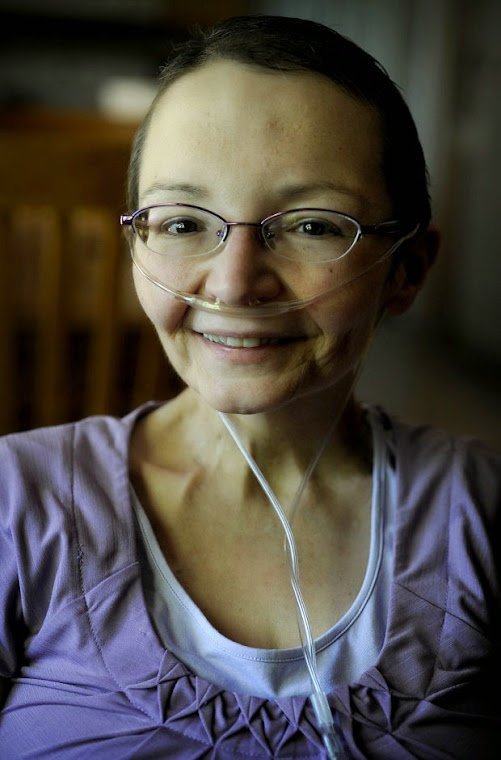
Daily Herald picture
Showing posts with label CT scans. Show all posts
Showing posts with label CT scans. Show all posts
Sunday, December 29, 2013

Thursday, December 26, 2013
PET Scan Time
It's almost rude.
It's 8:15 am the day after Christmas; and, once again, I'm forced to focus in on Hodgkins lymphoma. This time it's because I need to be at UVRMC in Provo by 8:45 for a PET scan.
After four doses of Adcetris (brentuximab vedontin), it's time to see if that chemo has done it's job.
I hate how you have to register at a kiosk, by typing in your last name, first name, birth month and day, and the department you need. Then wait in a reception area to register.
So what was that registration at the kiosk? And what was that phone call I answered about three days ago to pre-register?
I have to answer questions over the phone to pre-register, register at a kiosk, and then wait to register again for the final time?
Someone needs to fix this system!
It's also interesting to me that IHC hospitals require a finger poke to check liver function before they'll let you absorb contrast into your body. (To whine for a moment, I hate the finger pokes. I'd rather you draw my blood than poke my finger; a needle stick hurts less than the puncture wound.)
Plus, lately, it's not just a simple poke. They really have to jab deep because they're filling three pipettes (or small tubes) with blood. I know they're also testing blood glucose levels, but diabetic meters are all boasting how little blood they require these days--less than a drop.
So why three pipettes? Why the deep stab? Why the 2-3 minute process to "milk" my finger and squeeze all the blood you possibly can from the end of my nerve-damaged finger?
Luckily, the first part of the process goes fairly smoothly: access the port, inject the radioactive sugar, dim the lights and have me recline in a chair and wait 70 minutes while occasionally drinking about 16 oz. of oral contrast.
As I'm resting, I'm trying to count how many PET scans I have thus far in my life: at least 4-5 in the portable trailer at American Fork Hospital, at least 2 at Huntsman, one at the hospital off 5300 South in Salt Lake, and now this one at UVRMC. At least 8 total, and I'm pretty sure I'm forgetting at least two. Whew!
From all of those PET scans, I'm getting really good at judging how much time has passed while I'm resting and waiting for any cancerous lymph nodes in my body to absorb the radioactive sugar. Try it. If you're forced to rest in a dim room and do absolutely nothing but sit and wait, can you judge when 60-70 minutes are up?
Time for the CT and PET scans. Nothing new there either. Lay down on my back on a narrow hard table with my head in a strange foam pillow, arms above my head, stay absolutely still as the machine does 2-3 quick passes for the CT scan without contrast, then continue as the machine starts at my knees and spins about five minute, then moves to the next position (for a total of five different positions) until about 30 minutes have passed, then inject the IV contrast (that makes your lower abdomen feel very warm--like you've wet yourself) and wait for another 1-2 quick passes of the CT scan with contrast.
Ta-duh! Unhook the contrast tubing, flush the port, de-access the port, and you're now free to leave the premises with no hint as to any results.
Isn't modern medicine fun? lol
It's 8:15 am the day after Christmas; and, once again, I'm forced to focus in on Hodgkins lymphoma. This time it's because I need to be at UVRMC in Provo by 8:45 for a PET scan.
After four doses of Adcetris (brentuximab vedontin), it's time to see if that chemo has done it's job.
I hate how you have to register at a kiosk, by typing in your last name, first name, birth month and day, and the department you need. Then wait in a reception area to register.
So what was that registration at the kiosk? And what was that phone call I answered about three days ago to pre-register?
I have to answer questions over the phone to pre-register, register at a kiosk, and then wait to register again for the final time?
Someone needs to fix this system!
It's also interesting to me that IHC hospitals require a finger poke to check liver function before they'll let you absorb contrast into your body. (To whine for a moment, I hate the finger pokes. I'd rather you draw my blood than poke my finger; a needle stick hurts less than the puncture wound.)
Plus, lately, it's not just a simple poke. They really have to jab deep because they're filling three pipettes (or small tubes) with blood. I know they're also testing blood glucose levels, but diabetic meters are all boasting how little blood they require these days--less than a drop.
So why three pipettes? Why the deep stab? Why the 2-3 minute process to "milk" my finger and squeeze all the blood you possibly can from the end of my nerve-damaged finger?
Luckily, the first part of the process goes fairly smoothly: access the port, inject the radioactive sugar, dim the lights and have me recline in a chair and wait 70 minutes while occasionally drinking about 16 oz. of oral contrast.
As I'm resting, I'm trying to count how many PET scans I have thus far in my life: at least 4-5 in the portable trailer at American Fork Hospital, at least 2 at Huntsman, one at the hospital off 5300 South in Salt Lake, and now this one at UVRMC. At least 8 total, and I'm pretty sure I'm forgetting at least two. Whew!
From all of those PET scans, I'm getting really good at judging how much time has passed while I'm resting and waiting for any cancerous lymph nodes in my body to absorb the radioactive sugar. Try it. If you're forced to rest in a dim room and do absolutely nothing but sit and wait, can you judge when 60-70 minutes are up?
Time for the CT and PET scans. Nothing new there either. Lay down on my back on a narrow hard table with my head in a strange foam pillow, arms above my head, stay absolutely still as the machine does 2-3 quick passes for the CT scan without contrast, then continue as the machine starts at my knees and spins about five minute, then moves to the next position (for a total of five different positions) until about 30 minutes have passed, then inject the IV contrast (that makes your lower abdomen feel very warm--like you've wet yourself) and wait for another 1-2 quick passes of the CT scan with contrast.
Ta-duh! Unhook the contrast tubing, flush the port, de-access the port, and you're now free to leave the premises with no hint as to any results.
Isn't modern medicine fun? lol
Wednesday, March 20, 2013
CT Scans and Contrast
It's the day before my CT scan is scheduled, so I have to pick up oral contrast to drink tonight and tomorrow morning before the scan.
On my drive over to Central Utah Clinic's (CUC) Imaging Department, I start thinking about all of the radiologic scans I've had for cancer over the years, lymphangiograms, CT scans, PET scans. I'll bet the numbers are starting to approach 100 (or at least it feels that way to me). That's a lot of contrast that my body has had to deal with.
Every time I have a scan, the technologists seem surprised that I'm not diabetic yet, like my body (pancreas, kidneys, and liver mostly) hasn't started refusing to work properly because of everything it's been subject to so far.
Actually, now that I'm thinking about it, it seems like I was told in the last month or so that my liver enzymes weren't quite normal in a recent blood count and I should start watching that.
Now, I'm a little paranoid about the amount of contrast that I've been pouring into my body; and I'm on the way to pick up two more bottles of the stuff? Not to mention the IV contrast they'll also shoot through my port?
And there's no accounting for body type or size in the contrast they hand you. "CT Scan of the abdomen? Here, drink these two bottles." It didn't matter if I had the scans done when I weighed 231 pounds or now that I'm down to 164 pounds. They want me to pour the same amount of junk into my body and let my kidneys and liver fight to filter it out. That just doesn't seem right.
I arrive at the Imaging Department a little ticked off at Central Utah Clinic's protocols. Huntsman Cancer Institute in Salt Lake City doesn't use any contrast--oral or IV--for PET scans, which are even more detailed than CT scans, because their radiologists have realized the contrast doesn't improve the quality of the pictures enough to justify the potential havoc it can wreak on already-weakened bodies.
So I ask to speak to the radiologist at CUC. Surely, they've got to give some on the amount of contrast they demand when considering my body and all it's been through.
I'm politely told that the radiologist is in a procedure with another patient and they don't usually talk to patients anyway. It's okay. I'm determined. I'll wait. Exasperated by my stubbornness to be heard, the receptionist goes to find a technician that will talk to me. I can hear part of their interchange as I wait at the desk.
"I'll go talk to her. The radiologist is busy."
"Yeah, good luck with that."
So I start telling the technologist that I'm worried about pouring more contrast into my body when it's obviously been through so much already, and that there's no consideration for body type or mass taken into account when handing out contrast.
"You're a male, professional defensive linebacker who's 6'5" and 350 pounds? Great. Drink these two bottles of contrast." "You're a female cancer patient who's 5'0" and 164 pounds? Great. Drink these two bottles of contrast."
Then, and only then am I offered a different style of contrast. One that doesn't take the body 4-5 days to break down, just a couple hours, and one that doesn't have any known side affects or possibility of damaging bodies. I just need to arrive tomorrow morning an hour earlier so I can drink it in the office.
Why aren't patients made aware of the choices they have unless they really push back--hard!--at what's being asked of them?
I arrive the next morning an hour earlier and am asked to drink about half of the volume of what those two bottles of contrast contained. I still leave about a swallowful of the new contrast in the bottom of the glass, just on principle! But I'm pleasantly surprised to find that this new contrast tastes much better. No chalky, milky stuff that I'm afraid my body is conditioned to gag on by now. Instead, it's almost a translucent tart substance.
So I didn't convince them not to give my any contrast, but at least we found a less dangerous and less volume (that still isn't based on my body type or size) compromise.
It pays to speak up and advocate for yourself!
On my drive over to Central Utah Clinic's (CUC) Imaging Department, I start thinking about all of the radiologic scans I've had for cancer over the years, lymphangiograms, CT scans, PET scans. I'll bet the numbers are starting to approach 100 (or at least it feels that way to me). That's a lot of contrast that my body has had to deal with.
Every time I have a scan, the technologists seem surprised that I'm not diabetic yet, like my body (pancreas, kidneys, and liver mostly) hasn't started refusing to work properly because of everything it's been subject to so far.
Actually, now that I'm thinking about it, it seems like I was told in the last month or so that my liver enzymes weren't quite normal in a recent blood count and I should start watching that.
Now, I'm a little paranoid about the amount of contrast that I've been pouring into my body; and I'm on the way to pick up two more bottles of the stuff? Not to mention the IV contrast they'll also shoot through my port?
And there's no accounting for body type or size in the contrast they hand you. "CT Scan of the abdomen? Here, drink these two bottles." It didn't matter if I had the scans done when I weighed 231 pounds or now that I'm down to 164 pounds. They want me to pour the same amount of junk into my body and let my kidneys and liver fight to filter it out. That just doesn't seem right.
I arrive at the Imaging Department a little ticked off at Central Utah Clinic's protocols. Huntsman Cancer Institute in Salt Lake City doesn't use any contrast--oral or IV--for PET scans, which are even more detailed than CT scans, because their radiologists have realized the contrast doesn't improve the quality of the pictures enough to justify the potential havoc it can wreak on already-weakened bodies.
So I ask to speak to the radiologist at CUC. Surely, they've got to give some on the amount of contrast they demand when considering my body and all it's been through.
I'm politely told that the radiologist is in a procedure with another patient and they don't usually talk to patients anyway. It's okay. I'm determined. I'll wait. Exasperated by my stubbornness to be heard, the receptionist goes to find a technician that will talk to me. I can hear part of their interchange as I wait at the desk.
"I'll go talk to her. The radiologist is busy."
"Yeah, good luck with that."
So I start telling the technologist that I'm worried about pouring more contrast into my body when it's obviously been through so much already, and that there's no consideration for body type or mass taken into account when handing out contrast.
"You're a male, professional defensive linebacker who's 6'5" and 350 pounds? Great. Drink these two bottles of contrast." "You're a female cancer patient who's 5'0" and 164 pounds? Great. Drink these two bottles of contrast."
Then, and only then am I offered a different style of contrast. One that doesn't take the body 4-5 days to break down, just a couple hours, and one that doesn't have any known side affects or possibility of damaging bodies. I just need to arrive tomorrow morning an hour earlier so I can drink it in the office.
Why aren't patients made aware of the choices they have unless they really push back--hard!--at what's being asked of them?
I arrive the next morning an hour earlier and am asked to drink about half of the volume of what those two bottles of contrast contained. I still leave about a swallowful of the new contrast in the bottom of the glass, just on principle! But I'm pleasantly surprised to find that this new contrast tastes much better. No chalky, milky stuff that I'm afraid my body is conditioned to gag on by now. Instead, it's almost a translucent tart substance.
So I didn't convince them not to give my any contrast, but at least we found a less dangerous and less volume (that still isn't based on my body type or size) compromise.
It pays to speak up and advocate for yourself!
Wednesday, October 10, 2012
Third Dose and CT Scans
It's Friday, October 5 and time for CT scans to see what affect the chemo has had after two doses. The CT goes pretty smoothly (besides having to drink TWO containers of that ghastly, chalky contrast material), so now it's just a wait until Wednesday when I'll find out the results.
Wednesday, October 10 comes and time for another appointment with Dr. Wendy. Whoops! No one told me she was out of town, so I'm meeting with another oncologist. Now, I feel like I'm the teacher and not the patient.
This doctor has never known anyone that's used Adcetris and wants me to fill her in on all of its subtleties and complexities. Wow!
After being grilled for about twenty minutes, she tells me the chemo is having some affect on the cancer, but she can't really say how much. It almost seems like she's so interested in hearing about Adcetris that she doesn't have time to tell me about how much it's helping. Oh well. I can get my own printout and read about the CT results.
Time for my third dose of chemo. While I'm waiting, I read the CT results.
In one place, it says that the largest tumor shrank from 37mm in length to 27mm in length. That's not a bad reduction. But I'm confused because the summary statement says that the same tumor shrank from 30mm to 27mm. That's not very much at all. Which one is accurate? The width shrunk only from 20mm to 16mm, so it's probably the second measurement. And none of the other tumors showed any reductions. Crud!
So which part of this treatment will "exceed all expectations"? If it's not the side effects and it's not the number of doses I'll need, what is it? I'm banking on that this chemo will keep the cancer away longer then the other treatments have. Okay. I can live with that!
When I go back the next day for my Neulasta shot, Paula (one of the nurses that's been there through all three of the past occurrences with me) looks up the original PET scan for me to see what size it reported. The largest tumor was 38mm x 20mm, so the reduction is better than I originally thought. 38-37mm down to 27mm is about a 25% reduction. Not bad. Just not gone yet and lots more doses to look forward to.
Comme si, comme ca.
Wednesday, October 10 comes and time for another appointment with Dr. Wendy. Whoops! No one told me she was out of town, so I'm meeting with another oncologist. Now, I feel like I'm the teacher and not the patient.
This doctor has never known anyone that's used Adcetris and wants me to fill her in on all of its subtleties and complexities. Wow!
After being grilled for about twenty minutes, she tells me the chemo is having some affect on the cancer, but she can't really say how much. It almost seems like she's so interested in hearing about Adcetris that she doesn't have time to tell me about how much it's helping. Oh well. I can get my own printout and read about the CT results.
Time for my third dose of chemo. While I'm waiting, I read the CT results.
In one place, it says that the largest tumor shrank from 37mm in length to 27mm in length. That's not a bad reduction. But I'm confused because the summary statement says that the same tumor shrank from 30mm to 27mm. That's not very much at all. Which one is accurate? The width shrunk only from 20mm to 16mm, so it's probably the second measurement. And none of the other tumors showed any reductions. Crud!
So which part of this treatment will "exceed all expectations"? If it's not the side effects and it's not the number of doses I'll need, what is it? I'm banking on that this chemo will keep the cancer away longer then the other treatments have. Okay. I can live with that!
When I go back the next day for my Neulasta shot, Paula (one of the nurses that's been there through all three of the past occurrences with me) looks up the original PET scan for me to see what size it reported. The largest tumor was 38mm x 20mm, so the reduction is better than I originally thought. 38-37mm down to 27mm is about a 25% reduction. Not bad. Just not gone yet and lots more doses to look forward to.
Comme si, comme ca.
Subscribe to:
Posts (Atom)